
Snow leopard conservation in Mongolia centres on protecting the country’s estimated 953 cats — the world’s second-largest population — through a combination of national protected areas, community-based herder programmes, anti-poaching enforcement, and international partnerships under the Global Snow Leopard and Ecosystem Protection Programme (GSLEP). The species is listed as Vulnerable on the IUCN Red List, and Mongolia is one of 12 GSLEP range countries committed to securing 20+ snow leopard landscapes worldwide.
Key Takeaways
- Mongolia hosts an estimated 953 snow leopards (range 806–1,127) — the world’s second-largest population after China
- Listed as Vulnerable on the IUCN Red List with a global population of 4,000–6,500 mature individuals
- Major threats: livestock-retaliation killing, poaching for bones and pelts, prey-base loss, and climate-driven habitat shifts
- Mongolia is a signatory of the Bishkek Declaration (2013) and a partner in the GSLEP programme
- Domestic legal protection is provided under Mongolia’s Law on Fauna (2000), the Special Protected Areas system, and the 2016 creation of Tost-Tosonbumba Nature Reserve
- Community programmes (Snow Leopard Enterprises, Land of Snow, ranger-of-the-year awards) bring herder families directly into conservation
- Visitors can help by booking with operators that contribute to local conservation, donating to research, and respecting field-ethics rules in protected areas
Why Does Mongolia Matter for Global Snow Leopard Conservation?
The snow leopard (Panthera uncia) lives across the high mountains of 12 countries of Central and South Asia — Afghanistan, Bhutan, China, India, Kazakhstan, Kyrgyzstan, Mongolia, Nepal, Pakistan, Russia, Tajikistan, and Uzbekistan. Globally, the species is listed as Vulnerable on the IUCN Red List, with an estimated total population of 4,000–6,500 mature individuals.
Within that range, two countries dominate the count:
| Country | Estimated population | Approx % of global total |
|---|---|---|
| China | 2,000–2,500 | ~50 % |
| Mongolia | ~953 (range 806–1,127) | ~20 % |
| India | ~700–750 | ~15 % |
| Pakistan | ~250–420 | ~6 % |
| Other 8 countries (combined) | ~600–1,000 | ~10 % |
Mongolia’s population, confirmed by the 2017–2022 World Snow Leopard Population Assessment Initiative, is continuous with China’s, sharing genetic flow across the Altai, Gobi-Altai, and Sayan mountain spines. Losing Mongolia would not just remove a fifth of the global population in headcount terms — it would fragment the genetic backbone of the species.
This is why almost every major international conservation organisation working on snow leopards has a Mongolia programme, and why the country is treated as one of the three or four highest-priority range states in the global recovery strategy.
What Threats Do Snow Leopards in Mongolia Face?
The threats have shifted in character over the past two decades. Old threats persist; new ones have intensified.
Threat 1 — Livestock-retaliation killing
When snow leopards take goats, sheep, or yaks from herder camps, the financial loss to a Mongolian pastoral family can be severe — a single multi-livestock attack can cost 6–12 months of household income. Retaliation killing — shooting, poisoning, or setting snares — has historically been the largest direct mortality cause in many Mongolian populations. Recent years have seen a measurable rise in livestock numbers across the country (more than 70 million head as of recent counts), which has pushed pastures further into snow leopard territory and increased encounter rates.
Threat 2 — Poaching for bones, pelts, and trade
Demand for snow leopard parts — particularly bones used in some traditional medicine markets — drives illegal hunting and the cross-border trade. Pelts also still appear occasionally in domestic markets. Mongolia’s long international borders with Russia and China create enforcement difficulty in remote areas.
Threat 3 — Prey-base loss
Snow leopards depend on ibex and argali sheep as their primary wild prey. Overgrazing by domestic livestock reduces the alpine pastures that wild ungulates need; legal and illegal hunting of ibex and argali continues to depress prey densities in some ranges. Less wild prey means more livestock predation, which loops back into Threat 1.
Threat 4 — Climate change and water stress
Mongolia’s snow leopard ranges are warming faster than the global average. Modelling suggests shrinking high-elevation cold habitat, more frequent droughts, and shifting prey distributions within the next 30 years. Drinking-water points are increasingly contested between wildlife and livestock.
Threat 5 — Infrastructure and mining
New roads, mining operations, and railway corridors fragment snow leopard habitat in the Gobi-Altai and Khangai. Each new linear feature reduces the ability of cats to move between subpopulations and find mates.

What Does Mongolian Law Say About Snow Leopards?
Mongolia has built one of the more comprehensive national legal frameworks for snow leopard protection in the GSLEP range:
| Instrument | Year | What it does |
|---|---|---|
| Law on Fauna | 2000 (revised) | Lists the snow leopard as a “Very Rare” species; bans hunting, capture, and trade; sets criminal penalties |
| Law on Special Protected Areas | 1994 (amended) | Creates the legal category of “Strictly Protected Area” + “National Park” + “Nature Reserve” — the architecture for protected snow leopard habitat |
| Bishkek Declaration | 2013 | Mongolia signed alongside 11 other range states; commits to GSLEP and to securing 20+ snow leopard landscapes |
| CITES Appendix I | 1975 | Mongolia is a party; international commercial trade in snow leopard parts is banned |
| Tost-Tosonbumba Nature Reserve | 2016 | First reserve in the country created specifically for snow leopards — 7,284 km² in South Gobi |
| Revised Law on Animals (in process) | 2024–2026 | Strengthens penalties for poaching; updates definitions to current science |
Enforcement is the persistent gap. Poaching cases are difficult to prosecute in remote rangelands; courtroom evidence standards for wildlife crimes are still maturing. The 2024 Best Rangers of Snow Leopard Areas Awards Ceremony, organised by the Snow Leopard Conservation Foundation, is part of a deliberate push to raise the visibility and morale of the rangers who do most of the on-the-ground enforcement work.
Which Protected Areas Safeguard Snow Leopards in Mongolia?
Mongolia’s snow leopards are concentrated within a network of large protected areas across three mountain systems:
Altai (west)
- Altai Tavan Bogd National Park (6,362 km²) — the country’s largest single block of snow leopard habitat, with the highest density of cats
- Tsambagarav National Park — alpine ranges adjacent to Altai Tavan Bogd
- Sailyugem National Park — borderland with Russia; key for transboundary cat movement
Gobi-Altai (south)
- Great Gobi A Strictly Protected Area (44,190 km²) — vast desert-mountain habitat
- Great Gobi B Strictly Protected Area — smaller, but key for argali and ibex prey base
- Tost-Tosonbumba Nature Reserve (7,284 km², 2016) — the first reserve created specifically to protect snow leopards
Khangai and central ranges
- Khangai Nuruu National Park — central spine, lower density but important corridor
- Khorgo-Terkhiin Tsagaan Nuur National Park — northern Khangai habitat
These protected areas together cover roughly 20–25 % of Mongolia’s snow leopard habitat. Outside the boundaries, snow leopards still range widely, especially in the Khangai, where formal protection is sparser. This is why community-based programmes are essential — formal protection alone cannot reach every cat.
The Major Conservation Programmes Operating in Mongolia
Five programmes do most of the heavy lifting on the ground.
1 — Global Snow Leopard and Ecosystem Protection Programme (GSLEP)
Launched in 2013 with the Bishkek Declaration, GSLEP is the umbrella framework that coordinates all 12 range countries. Mongolia’s National Snow Leopard Ecosystem Protection Priorities (NSLEP) document, prepared under GSLEP, identifies five priority landscapes covering most of the country’s snow leopard population. The 2025 GSLEP Steering Committee meeting in Bishkek brought together environment ministers from across the range to renew commitments.
2 — Snow Leopard Conservation Foundation (SLCF) Mongolia
The Snow Leopard Conservation Foundation is Mongolia’s national-NGO counterpart to international partners. SLCF runs the country-wide ranger awards programme, coordinates with the Ministry of Environment, and convenes the National Forum on Snow Leopard Conservation (130+ stakeholders, multi-country) in Ulaanbaatar.
3 — Snow Leopard Trust + Panthera (long-term study at Tost)
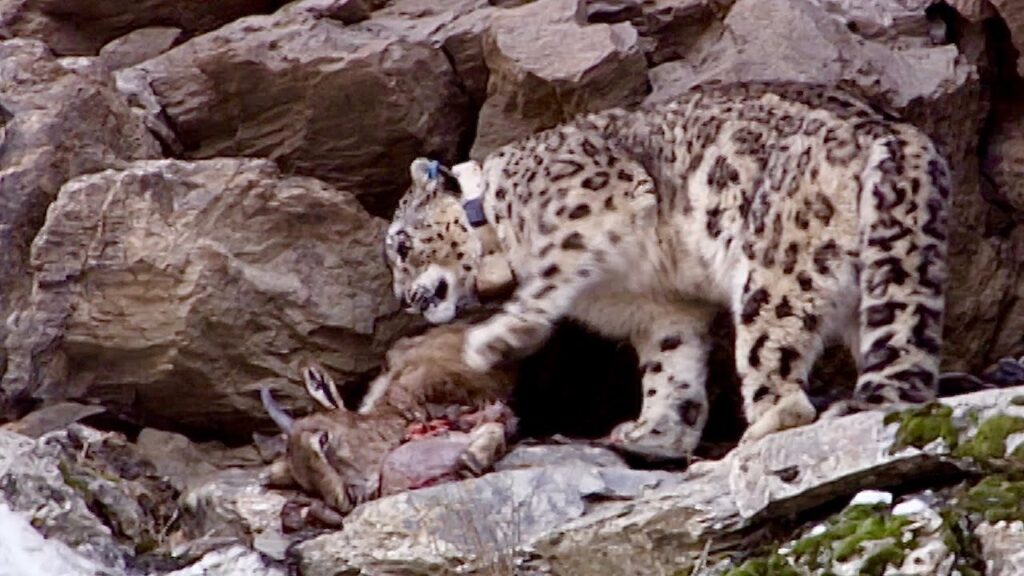
A 10-year ecological study at Tost-Tosonbumba — among the longest-running snow leopard studies anywhere — has radio-collared 15 individual cats and produced years of data on territory size, diet, mating success, and survival rates. The study informs nearly every other snow leopard conservation programme globally.
4 — WWF Mongolia: Land of Snow
WWF’s Land of Snow programme works on landscape-scale habitat protection across western Mongolia. Activities include herder education, retaliation-prevention infrastructure (predator-proof corral construction), and monitoring partnerships with government rangers.
5 — Wildlife Conservation Society (WCS) Mongolia
WCS Mongolia runs co-management programmes in the Mongolian Altai and supports the National Forum, with a particular focus on combating illegal wildlife trade and supporting transboundary efforts with Russian partners.
The programmes overlap deliberately. Each focuses on a different lever — policy, science, community, enforcement, public awareness — and together they form a layered defence around the species.
How Do Community-Based Projects Work?
The most effective long-term conservation tool in Mongolia has been paying herders to protect rather than punish snow leopards. Several models work in parallel:
Snow Leopard Enterprises (SLE)
Founded by Snow Leopard Trust in the early 2000s and now operating across Mongolia, Kyrgyzstan, and Pakistan, SLE pays herder families to produce handicrafts from sheep and yak wool — felt slippers, embroidered bags, woollen toys — sold to international donors. Families sign a community-wide “no-kill” pledge: if anyone in the participating community kills a snow leopard during the year, the entire community loses its annual bonus payment. This makes neighbours into mutual enforcers.
Over 300 families across the three countries participate, with annual income supplements that can equal a meaningful share of household revenue. In Mongolia, SLE communities have shown substantially lower retaliation-killing rates than non-participating control areas.
Predator-proof corrals
WWF, SLCF, and Snow Leopard Trust co-fund the construction of reinforced livestock corrals — tall stone or wire enclosures with covered tops — in high-conflict valleys. A snow leopard cannot enter a properly built corral, so a herder family wakes to find livestock alive and the cat gone, instead of the reverse. Corrals are simple but expensive (typically several hundred US dollars each) and require ongoing maintenance.
Livestock insurance
Several pilots in Mongolia compensate herders for verified snow-leopard-caused livestock loss in exchange for not retaliating. The schemes are technically demanding (verification by trained rangers, photo evidence, payment processing) but have shown promise in specific valleys when combined with corral and SLE programmes.
Ranger awards and capacity building
SLCF’s 2024 Best Rangers of Snow Leopard Areas ceremony recognised individual government rangers in the Altai, Gobi-Altai, and Khangai who tracked individual cats, reported poaching incidents, and led local education sessions. Recognition matters: ranger pay in Mongolia is modest, and visibility plus prestige are powerful retention tools.
The Science: Long-Term Research and Camera-Trap Monitoring
Conservation without science is guesswork. Mongolia hosts what is arguably the world’s deepest snow leopard data set, anchored by the long-term study at Tost-Tosonbumba.
Camera-trap monitoring
In late 2023, community rangers at Tost deployed 43 camera traps across the reserve. By the end of the 2024 monitoring season, 33 of those cameras had photographed snow leopards, generating 86 distinct encounters and identifying multiple individual cats by their unique rosette patterns.
Across Mongolia as a whole, the most recent assessment under the World Snow Leopard Population Assessment Initiative deployed camera traps across all major snow leopard landscapes between roughly 2017 and 2022, producing the 953 (806–1,127) national population figure that is now the working number for all conservation planning.
Radio collaring
The Tost study has radio-collared 15 individual snow leopards over its 18+ year run, producing years of GPS data on territory size, daily movement, prey selection, mating, and dispersal. Findings include:
- Average territory size: roughly 100–200 km² for resident adults in Tost
- Dispersal distances: documented juveniles moving 100+ km from natal areas
- Diet: ibex dominates, but Tost cats also take argali, marmot, and occasional livestock
- Cub survival: highly variable, strongly tied to prey availability
DNA, faecal, and prey monitoring
DNA from snow leopard scat is now routinely used to identify individual cats and confirm population density estimates. Prey monitoring using transect counts of ibex and argali provides early warning when prey numbers crash — usually before snow leopard numbers visibly fall.
How Can Visitors and Donors Help?
There are five practical, high-leverage ways non-Mongolians can contribute to snow leopard conservation in Mongolia.
1 — Book responsibly
If you visit, choose tour operators that contribute to local conservation rather than just running through landscapes. Reputable operators in Bayan-Ölgii and South Gobi maintain working relationships with ranger families, fund corral construction, and follow strict field ethics. For a structured introduction to the Altai range and its wildlife, see our Altai Tavan Bogd tour and the Mongolia Altai mountain tour.
2 — Donate to a research programme, not just a brand
The single most cost-effective conservation investment is sustained funding for long-term research and ranger salaries. Snow Leopard Trust’s Tost programme, WCS Mongolia’s enforcement work, and the Snow Leopard Conservation Foundation’s ranger awards programme all operate at the front line.
3 — Support Snow Leopard Enterprises
Buying handicrafts from SLE-participating herder communities directly raises household income in the families whose pledge-not-to-kill is the lynchpin of community conservation. Even modest annual purchases compound across the participating community network.
4 — Respect field ethics if you go
Inside protected areas, follow the no-approach-within-200m rule, no-drone rule, no-bait rule. A snow leopard winters at the edge of its energy budget; harassment can mean starvation. Reputable trackers will turn back the moment a cat shows discomfort.
5 — Pair your visit with a sighting expedition
A guided winter expedition is one of the few non-academic activities that funds the local field economy that sustains conservation. Specialist trackers, herder hosts, ranger guides, and the ger-camp infrastructure that supports them are all kept viable in part by responsible visitor demand. See our practical guide to snow leopard sightings in Mongolia for what to expect.
The cumulative effect: a moderately well-managed snow leopard tour brings in roughly enough revenue per traveller to fund several months of one ranger’s wages or one predator-proof corral. Across a season, that becomes meaningful conservation.
Suggested Tours:
Suggested Blogs:
Snow Leopard Photography Gear Guide: What You Actually Need for the Altai
To photograph snow leopards in the Mongolia Altai, you need a weather-sealed camera body, a telephoto lens of at least…Altai Argali, Ibex and Snow Leopard: The Prey-Predator Chain That Holds the Mountain Ecosystem Together
The Altai Mountains snow leopard population depends entirely on a small set of prey species: Altai argali (the world’s largest…Best Months to See Snow Leopards in the Altai: A Seasonal Guide for 2026
The best months to see snow leopards in Mongolia’s Altai Mountains are February through early April. Three biological factors converge…





How many snow leopards are left in Mongolia?
The most recent national assessment, conducted under the World Snow Leopard Population Assessment Initiative between roughly 2017 and 2022, estimates Mongolia hosts 953 snow leopards (range 806–1,127). This makes Mongolia home to the world’s second-largest population after China and roughly 20 percent of the global total.
Is the snow leopard endangered?
The snow leopard is currently listed as Vulnerable on the IUCN Red List, downlisted from Endangered in 2017 after improved population estimates. Vulnerable means the species still faces a high risk of extinction in the wild but at a lower level than Endangered. The total mature population globally is estimated at 4,000–6,500 individuals across 12 range countries.
What is the biggest threat to snow leopards in Mongolia?
Historically, the largest direct mortality cause has been retaliation killing by herders after livestock attacks. Current evidence suggests this remains the leading threat in many Mongolian populations, alongside poaching for bones and pelts, loss of wild prey from overgrazing and hunting pressure, and increasing climate-driven habitat shifts.
What is the Bishkek Declaration?
The Bishkek Declaration is the founding agreement of the Global Snow Leopard and Ecosystem Protection Programme (GSLEP), signed in 2013 by all 12 snow leopard range countries including Mongolia. It commits each country to identifying and securing at least 20 snow leopard landscapes worldwide and to coordinated transboundary action on poaching, prey-base management, and climate adaptation.
How can I help snow leopard conservation in Mongolia?
Five practical options: (1) book a responsible tour operator that funds local conservation, (2) donate directly to a long-term research or ranger programme rather than to brand-name fundraising, (3) buy handicrafts from Snow Leopard Enterprises herder communities, (4) follow strict field ethics if you visit, and (5) pair any visit with a guided expedition that funds the local conservation economy.
What is Tost-Tosonbumba Nature Reserve?
Tost-Tosonbumba is a 7,284 km² protected area in Mongolia’s South Gobi, established in 2016 as the first reserve in the country created specifically to protect snow leopards. It hosts the long-running Snow Leopard Trust ecological study, has been monitored continuously for over 18 years, and produced 86 distinct snow leopard encounters from 33 of 43 camera traps deployed in 2024.
Are snow leopards protected by Mongolian law?
Yes. The species is listed as Very Rare under Mongolia’s 2000 Law on Fauna, which bans hunting, capture, and trade with criminal penalties. Mongolia is a party to CITES Appendix I, which bans international commercial trade in snow leopard parts. The country also signed the 2013 Bishkek Declaration and is currently revising the broader Law on Animals to strengthen penalties further.