
The snow leopard (Panthera uncia) is one of the most striking and elusive big cats in the world, known for its unique appearance and ability to thrive in some of the most remote and rugged mountain regions of Central Asia.
Its remarkable adaptation to the cold, high-altitude environments is reflected in its distinctive physical characteristics, which not only allow it to survive but also to excel as an apex predator in these harsh ecosystems.
We offer you MONGOLIA SNOW LEOPARD PHOTOGRAPHY TOUR. Mongolia is the world’s 18th biggest country by territory with only three million people living here. Over 1.5 million square kilometers of land is inhabited by the last nomads and unique wild animals like the red fox, grey wolf, and snow leopards. It will be wonderful 🤩🤩
Fur and Coloration
🐆 Want to experience this in person? Join our 6-Day Best of Altai Tavan Bogd Tour (snow leopard habitat) with local Kazakh guides — small groups, authentic experience, 5.0 stars on TripAdvisor.
One of the most notable aspects of the snow leopard’s appearance is its thick, luxurious fur. The snow leopard has a soft, dense undercoat that insulates it against the freezing temperatures of its natural habitat, which includes the Himalayas, the Tibetan Plateau, and the Altai Mountains.
This undercoat is covered by a longer, coarser layer of fur that serves to protect the animal from the elements.
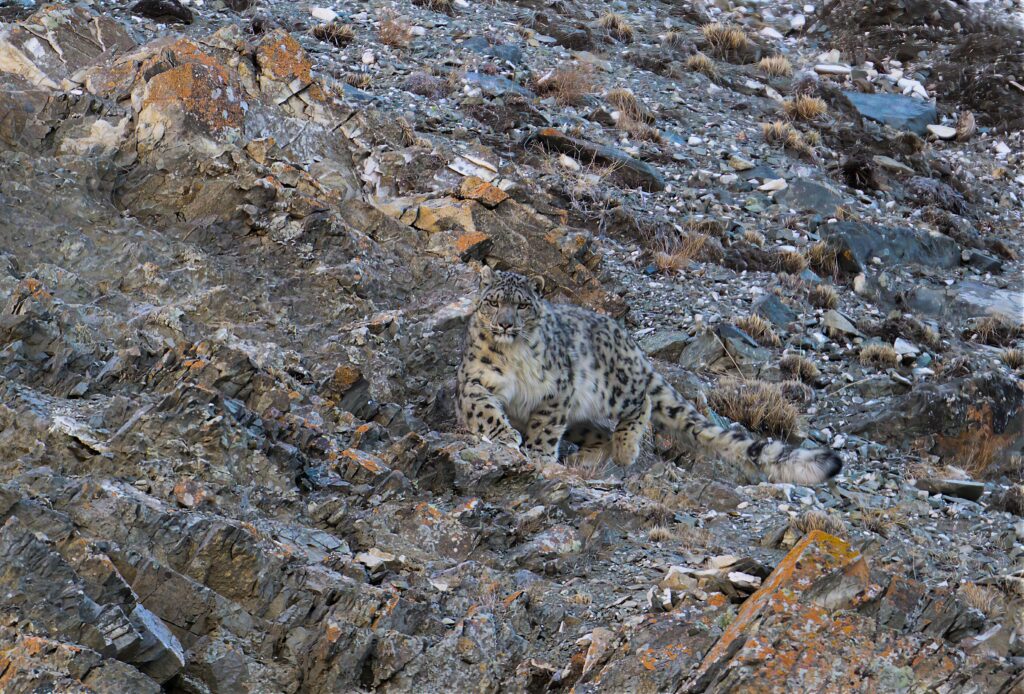
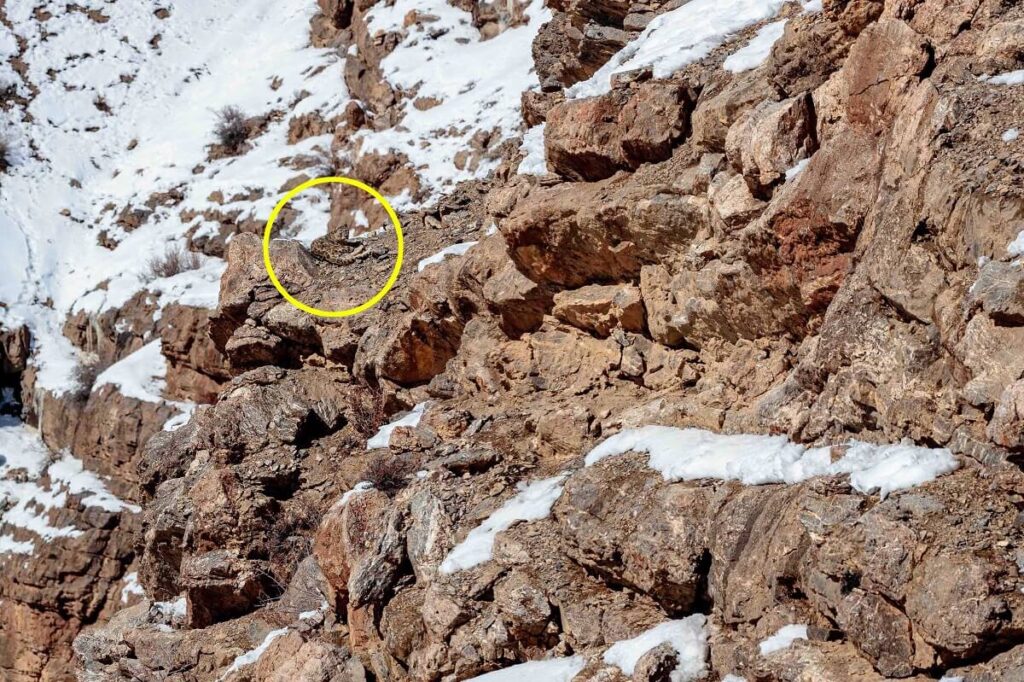
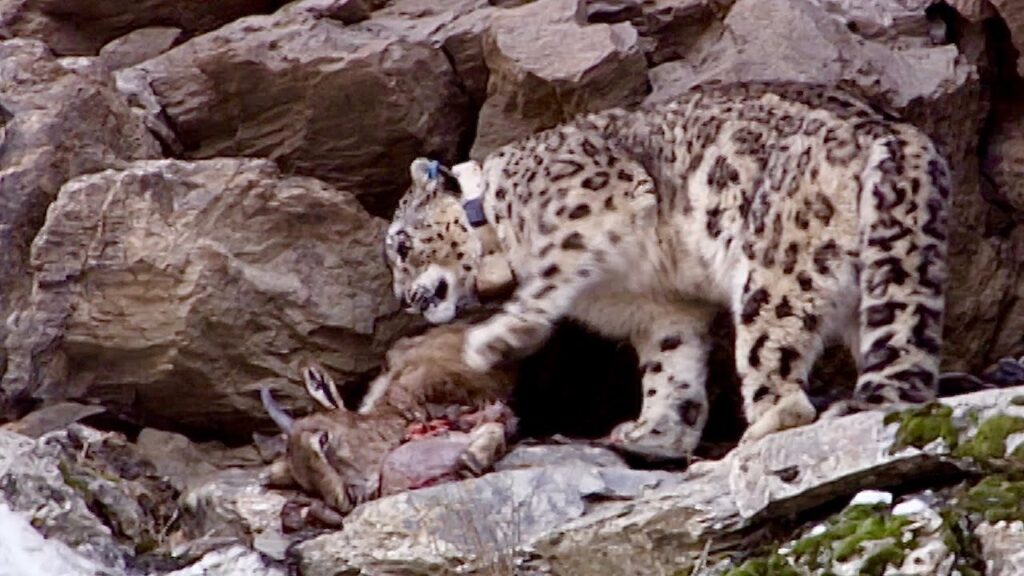
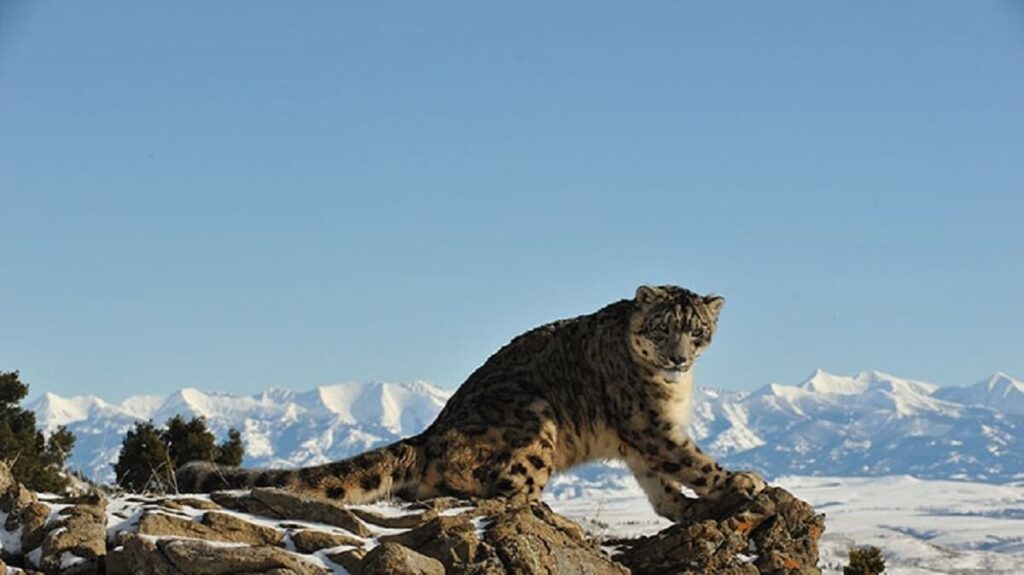
The color of its fur is primarily a pale smoky-grey, which is beautifully mottled with black or dark-grey rosettes and spots. These spots, which are irregular in shape and size, help the snow leopard blend into its rocky, snowy surroundings.
The underbelly, chest, and inner legs are typically lighter in color, almost white. This overall coloration provides the perfect camouflage against the snow-dappled rocks and alpine meadows where the snow leopard makes its home. The fur pattern and color help it remain inconspicuous to both its prey and potential threats.

Head and Facial Features
The snow leopard’s face is also distinct, with a short, broad head and a rounded, compact nose. Its skull is robust, which supports powerful jaw muscles, aiding in the killing of prey.
Its eyes are large and set in a forward position, giving the snow leopard excellent binocular vision, which is crucial for spotting prey from long distances in open or semi-open environments.
One of the most captivating features of the snow leopard is its striking eyes, which range from pale green to grey, unlike many other big cats, which tend to have yellow or amber eyes.
This eye color, combined with its thick fur and elegant features, gives the snow leopard a serene and ghostly appearance, contributing to its reputation as the “Ghost of the Mountains.”
The snow leopard’s ears are small and rounded, helping it to minimize heat loss in the cold environments it inhabits.
The black markings on the ears, which resemble an “M” shape, serve as a form of communication between individuals, especially when one snow leopard follows another along mountain trails.

Body Structure and Adaptations
Physically, the snow leopard is built for agility and power. It is smaller compared to other big cats, with adults typically weighing between 27 to 55 kg (60 to 121 lbs), though larger individuals have been reported. Males tend to be slightly larger than females.
Its body length, excluding the tail, ranges from 90 to 130 cm (35 to 51 inches), while its tail adds an additional 80 to 100 cm (31 to 39 inches) to its overall length.
The snow leopard’s body is muscular yet lean, designed for speed and strength, allowing it to traverse the rugged, vertical terrains it calls home. Its legs are relatively short but incredibly powerful, enabling it to leap great distances—up to 15 meters (49 feet) in a single bound. This ability is essential when chasing prey or navigating steep cliffs and rocky outcrops.
The snow leopard’s paws are large and wide, functioning like natural snowshoes. These wide paws help distribute the animal’s weight across soft snow, preventing it from sinking too deeply.
The paws are also equipped with fur on the soles, providing extra insulation against the cold and additional grip on slippery surfaces.

Tail and Balance
Perhaps one of the snow leopard’s most distinctive features is its long, thick tail. Measuring almost as long as its body, the snow leopard’s tail is not only a tool for balance but also serves as a thermal blanket.
When resting or sleeping in freezing temperatures, the snow leopard will often wrap its tail around its body, using it to shield itself from the cold wind.
The tail’s muscularity and length allow the snow leopard to maintain balance while moving across precarious, rocky terrain or leaping between crags. This is essential for survival in its mountainous habitat, where falls could be fatal.

Stealth and Elegance
All of these features combine to make the snow leopard a model of stealth and elegance. Its appearance is not only beautiful but also perfectly adapted to its challenging environment.
From its thick fur to its agile body, each element of the snow leopard’s appearance plays a critical role in its ability to survive and thrive in one of the most inhospitable regions on Earth.

In conclusion, the snow leopard’s appearance is an exquisite blend of beauty and practicality, evolved to master the high-altitude terrains it inhabits. Its unique physical traits—dense fur, powerful limbs, long tail, and striking eyes—create an image of both grace and strength, cementing its status as one of nature’s most fascinating creatures.
Suggested tour:
MONGOLIA SNOW LEOPARD PHOTOGRAPHY TOUR
Unleash your adventure spirit, explore Mongolia on your own terms MONGOLIA SNOW LEOPARD PHOTOGRAPHY TOUR ⭐⭐⭐⭐⭐ 5.0 · 72 reviews…MONGOLIA WINTER TOUR
Unleash your adventure spirit, explore Mongolia on your own terms MONGOLIA WINTER TOUR ⭐⭐⭐⭐⭐ 5.0 · 72 reviews on TripAdvisor…MONGOLIA HORSE TREKKING TOUR 2027
Unleash your adventure spirit, explore Mongolia on your own terms MONGOLIA HORSE TREKKING TOUR 2027 ⭐⭐⭐⭐⭐ 5.0 · 72 reviews…
Related content:
Snow Leopard Photography Gear Guide: What You Actually Need for the Altai
To photograph snow leopards in the Mongolia Altai, you need a weather-sealed camera body, a telephoto lens of at least…Altai Argali, Ibex and Snow Leopard: The Prey-Predator Chain That Holds the Mountain Ecosystem Together
The Altai Mountains snow leopard population depends entirely on a small set of prey species: Altai argali (the world’s largest…Best Months to See Snow Leopards in the Altai: A Seasonal Guide for 2026
The best months to see snow leopards in Mongolia’s Altai Mountains are February through early April. Three biological factors converge…



Physical Measurements and Size Specifications
Adult snow leopards stand 55-65 cm (22-26 inches) at shoulder height, with a body length of 90-115 cm (36-44 inches) and a tail measuring approximately 100 cm (40 inches) — nearly as long as the body itself.
Males typically weigh 45-55 kg (100-120 lbs), while females are smaller at 35-40 kg (75-90 lbs).
The paw size represents approximately 10% of their total body size, significantly larger proportionally than tigers (6%), which helps distribute weight across snow.
Respiratory and Thermoregulatory Adaptations
Snow leopards possess specially enlarged nasal cavities that warm frigid mountain air before it reaches the lungs, preventing tissue damage in subzero temperatures.
The nasal passages contain exceptionally large and dense turbinates — maze-like structures of bone and tissue that facilitate heat exchange between inhaled cold air and exhaled warm air.
Their domed skull structure allows for greater oxygen intake capacity, a critical adaptation for surviving in oxygen-poor environments above 3,000 meters elevation.
Short, rounded ears minimize surface area exposed to cold, reducing heat loss in temperatures that can drop below -40°C.
Fur density reaches approximately 25,806 hairs per square inch, with length varying from 2 inches in summer to 2.4 inches in winter, creating an insulating air layer next to the skin.
Locomotion and Hunting Performance
Snow leopards can leap horizontally across gorges spanning up to 50 feet (15 meters) and achieve vertical jumps of 6 feet from a standing position.
They possess elongated hind limbs similar to cheetahs, with uniquely elongated tibiae (lower leg bones) that enable faster acceleration and longer jumping distances compared to jaguars and other big cats.
During pursuit, snow leopards can reach speeds up to 40 miles per hour across steep, rocky terrain while hunting blue sheep (bharal) and Siberian ibex.
Their long, flexible lower spine allows them to extend and contract their bodies during running, covering more ground with each stride and rapidly changing direction by rebounding off rocky walls.
Snow leopards typically catch large prey every 8-10 days, consuming the carcass over several days.
Paw Structure and Snow Adaptation
The oversized paws function as natural snowshoes, distributing the cat’s weight across a larger surface area to prevent sinking into deep snow — similar to how traditional snowshoes work for humans.
The proportionally larger paw size (10% of body size vs. 6% in tigers) represents a key evolutionary trade-off: reduced ground pressure for snow travel in exchange for slightly less powerful strikes during hunts.
How big is a snow leopard compared to other big cats?
Snow leopards are among the smaller big cats, with males weighing 45-55 kg (100-120 lbs) and females 35-40 kg (75-90 lbs). They stand 55-65 cm tall at the shoulder with a body length of 90-115 cm, plus a tail nearly as long as the body at approximately 100 cm. This makes them significantly smaller than tigers and lions, but their compact size is actually an advantage in their extreme mountain habitat — smaller bodies require less food and oxygen in environments where both are scarce, while still maintaining enough power to take down prey like blue sheep and ibex.
How far can a snow leopard jump?
Snow leopards are exceptional jumpers, capable of leaping horizontally across gorges up to 50 feet (15 meters) wide and achieving vertical jumps of 6 feet from a standing position. This remarkable jumping ability comes from their elongated hind limbs and uniquely elongated tibia bones (lower leg bones), an adaptation they share only with cheetahs among big cats. During these acrobatic leaps across mountain terrain, their extra-long tail acts as a rudder for mid-air steering and as a counterbalance when changing direction.
How do snow leopards stay warm in extreme cold?
Snow leopards survive temperatures as low as -40°C through multiple specialized adaptations. Their fur is the longest and densest of all big cats, with approximately 25,806 hairs per square inch that grow from 2 inches in summer to 2.4 inches in winter, trapping an insulating layer of air against their skin. Their short, rounded ears minimize exposed surface area to reduce heat loss. The extra-long tail serves double duty: it provides balance during hunting, and when resting, snow leopards wrap it around their body and over their nose like a built-in scarf for additional warmth. Their enlarged nasal cavities also warm freezing air before it enters the lungs.
How fast can snow leopards run?
Snow leopards can reach speeds of up to 40 miles per hour when pursuing prey across steep, rocky mountain terrain. While this is slower than cheetahs (which can reach 70 mph on flat ground), snow leopards achieve this speed while navigating near-vertical slopes, loose scree, and deep snow — environments that would be impossible for most predators. Their elongated hind limbs provide rapid acceleration, while their long, flexible spine allows them to extend and contract their body with each stride, covering more ground quickly. This combination of speed and agility makes them formidable hunters in one of Earth’s most challenging environments.
Why do snow leopards have such big paws?
Snow leopards have disproportionately large paws — representing about 10% of their total body size compared to just 6% in tigers — to function as natural snowshoes. These oversized paws distribute their body weight across a larger surface area, preventing them from sinking into deep snow as they traverse their high-altitude habitat. The paws also feature thick fur growing between the pads and toes, which provides insulation against frozen ground and improves traction on ice and rock. This adaptation is critical for survival in the Altai Mountains and throughout their range, where snow cover can persist for much of the year.
Dreaming of seeing this face through your own lens? Our winter snow leopard photography expedition tracks wild cats in the Mongolian Altai every January to March.