
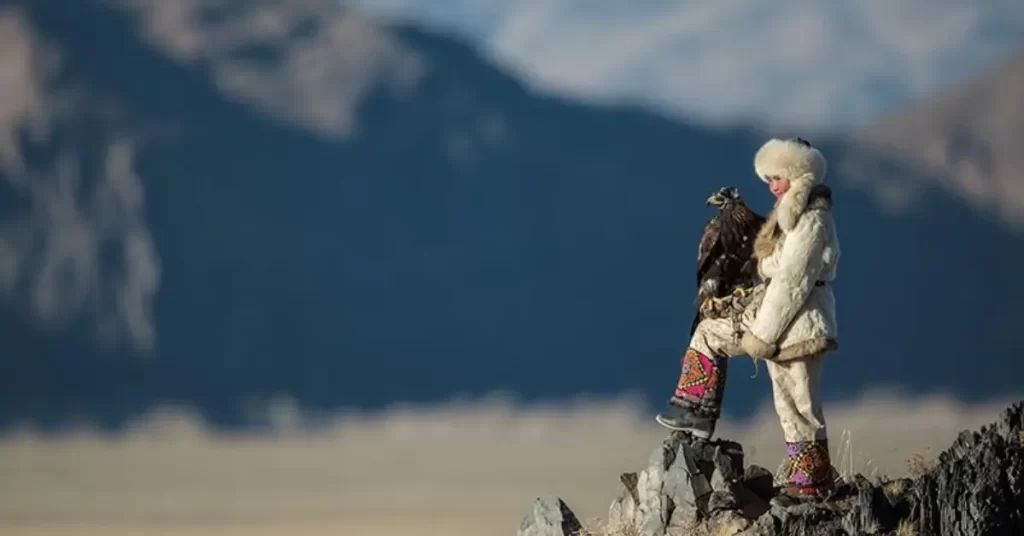
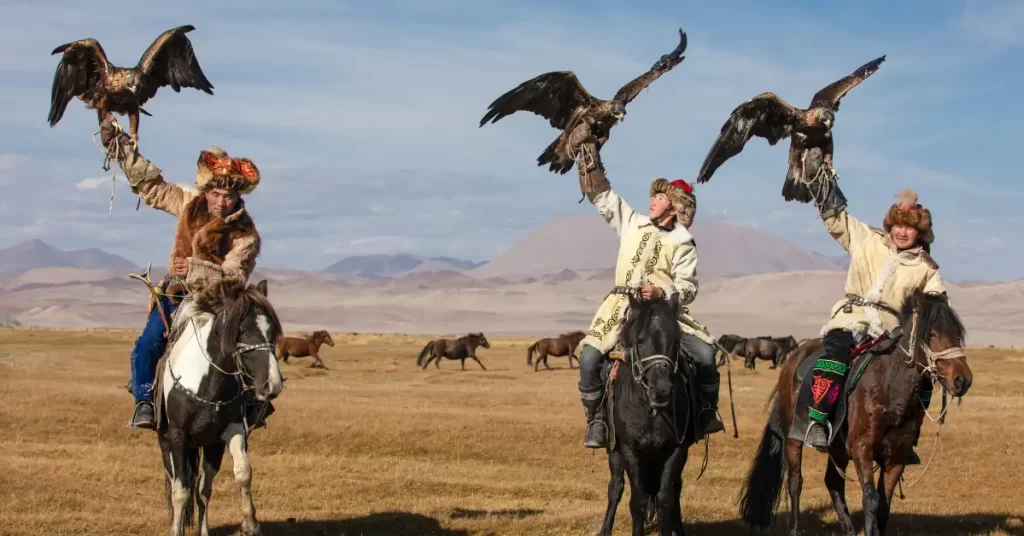
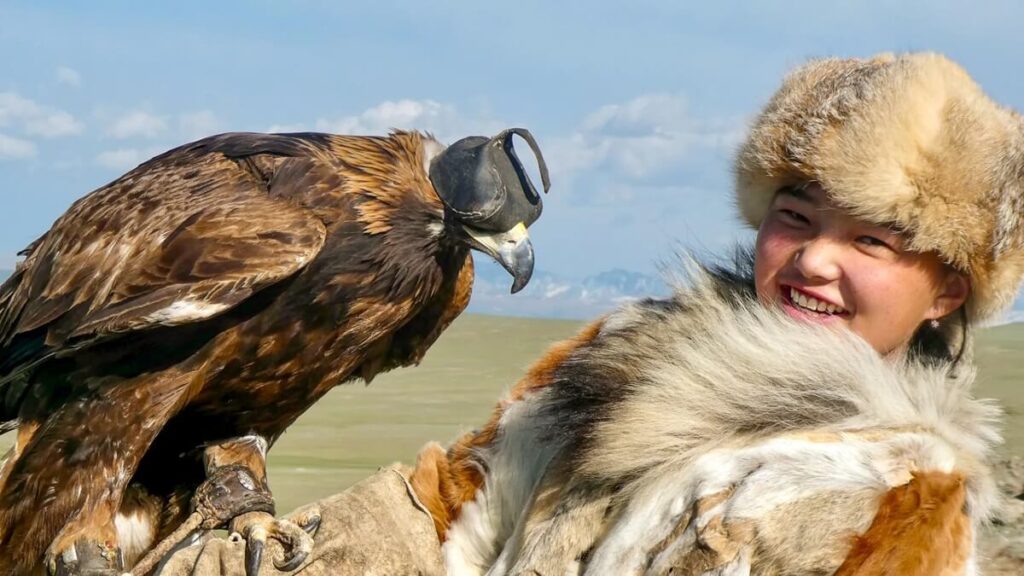
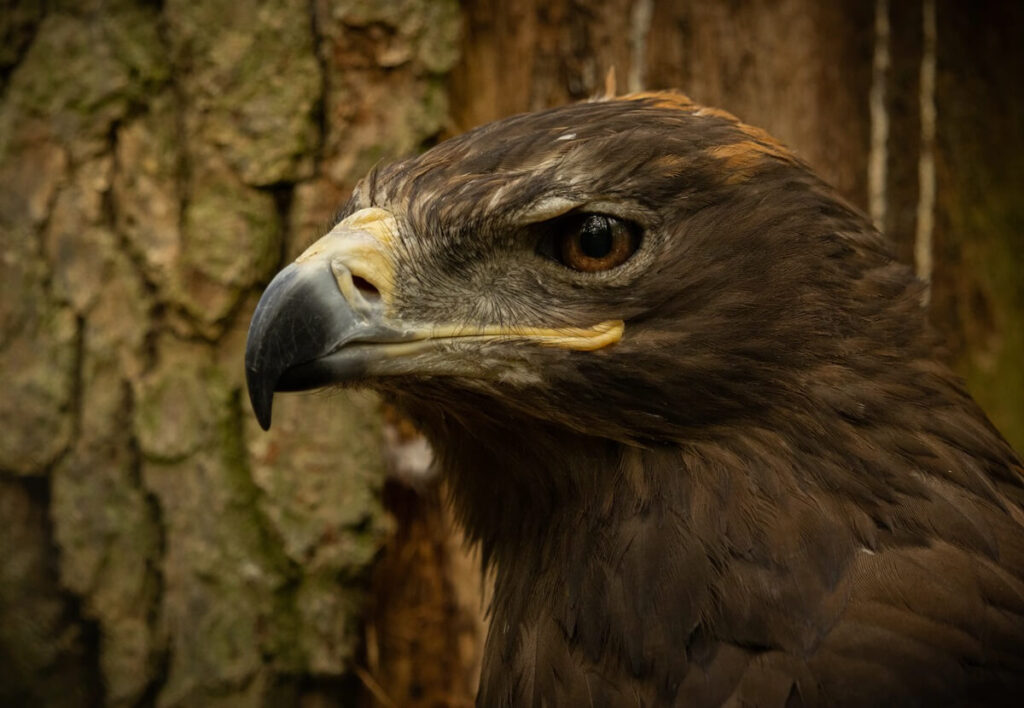
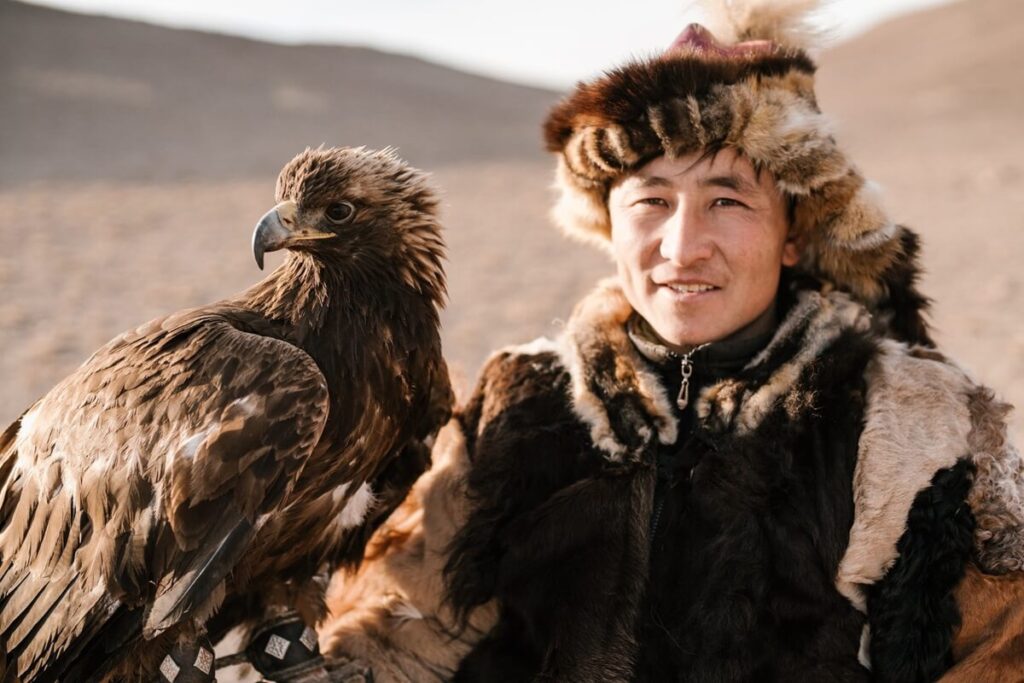
In Kazakh nomadic culture of Mongolia’s Altai Mountains, the golden eagle is far more than a hunting bird. She is a sacred partner, rooted in the ancient sky-god religion of Tengrism, whose practitioners viewed eagles as messengers between the upper, middle, and lower worlds. A Kazakh berkutchi (eagle hunter) trains a wild-caught female golden eagle for 5 to 10 years, then releases her back to the cliffs to breed. The relationship is governed by ritual, mutual respect, and the belief that the eagle’s spirit must remain free.
Key Takeaways
- Eagle hunting (berkutchi) is woven into the Tengrist spiritual worldview of Turkic and Mongolic peoples
- The golden eagle is regarded as a messenger between earth and sky — the realm of Tengri, the supreme sky god
- Kazakh tradition demands the eagle be released back to the wild after 5–10 years of partnership
- The mythical bird Samruk appears in Kazakh oral epic as a golden eagle that brought light to the world
- UNESCO inscribed falconry — including Mongolian Kazakh eagle hunting — as Intangible Cultural Heritage in 2010, expanded in 2021 to include Mongolia
- An estimated 400–500 active berkutchi practise today in Bayan-Ölgii, with the next generation under demographic strain
Why are Golden Eagles Sacred in Kazakh Culture?
To outsiders, eagle hunting can look like sport. Inside Kazakh nomadic life, it is a sacred relationship that touches almost every layer of culture — religion, music, family identity, and the rhythm of the pastoral year.
The sacredness rests on three pillars. First, the eagle is a creature of the upper world, and in the old steppe cosmology any animal that lives between earth and sky is closer to the divine than ground-dwellers. Second, the bird is chosen, not bought: a hunter takes a single juvenile from a cliff eyrie, and the rest of the partnership is shaped by what that bird turns out to be. Third, the relationship has a moral end-point — the eagle must be released back to the wild — which makes the entire arc more like a foster parenthood than ownership.
This is why a berkutchi speaks of his eagle the way a herder speaks of an honoured family member, and why the bird’s death is mourned with the same gravity a relative’s would be.
Tengrism and the Eagle as a Sky Messenger
The spiritual scaffolding behind Kazakh eagle reverence comes from Tengrism, the pre-Islamic sky-centred religion of the Turkic and Mongolic peoples. Tengrist cosmology divides the universe into three layers:
| Realm | Domain | Inhabitants |
|---|---|---|
| Upper World | Sky, light, celestial spirits | Tengri (supreme sky god), eagles, soaring birds |
| Middle World | Land, mountains, rivers | Humans, livestock, nature spirits |
| Lower World | Underworld, darkness | Erleg Khan, ancestors of the dead |
Tengri — whose name simply means “sky” in old Turkic — was understood as the all-encompassing god of heaven, source of light, and giver of mandate to khans. Eagles, soaring high enough to disappear into the blue, were treated as his messengers: birds that could carry petitions upward and bring back signs.
Even after most Kazakhs converted to Sunni Islam (the Bayan-Ölgii Kazakhs are predominantly Muslim today), Tengrist symbolism never fully left the steppe. Eagle imagery on the Kazakhstan flag, the use of eagle feathers in shamanic regalia of neighbouring Tuvan and Altaian peoples, and the careful release ritual at the end of the hunting partnership all carry the older logic forward.
The Samruk Legend: the Eagle That Brought Light
In Kazakh oral epic, the most famous eagle is not a real bird at all — it is Samruk, a mythical golden bird sometimes described with a human face, who is said to have brought light to a darkened world. In some tellings Samruk transforms between eagle and a beautiful woman, embodying a deep duality between the wild and the human.
Samruk roosts in the Tree of Life (Bäyterek), a cosmic tree that connects the three Tengrist worlds. Each year a serpent climbs the trunk to eat Samruk’s golden egg, and each year the eagle lays a new one — an endlessly renewing cycle of light, death, and rebirth.
The image is so foundational that the modern capital of Kazakhstan features a 105-metre Bäyterek monument with a stylised Samruk egg at its peak. For the Kazakhs of the Altai, the working bond between hunter and golden eagle is the everyday, earthly echo of this mythic relationship — a human reaching upward to partner with the bird that connects the worlds.
How Does the Spiritual Bond Shape the Partnership?
The training of an eagle is engineered to build trust, not domination. A hunter who breaks his eagle’s spirit cannot get her to fly back to him in the open mountains; she will simply leave. So every step of the relationship is calibrated to preserve her wildness while teaching her to choose to return.
The arc of a typical partnership:
| Year | Training stage | What it looks like |
|---|---|---|
| Year 1 | Capture & gentling | Female juvenile taken from a cliff eyrie at 3–4 months; hunter spends weeks beside her, hand-feeding her in dim ger light |
| Year 1–2 | Hood & glove conditioning | Eagle accepts the leather hood (tomaga); recall to the gloved fist using meat lures |
| Year 2–4 | Field hunting | First hunts on rabbits and corsac fox; eagle learns to recognise the hunter’s whistle from a kilometre away |
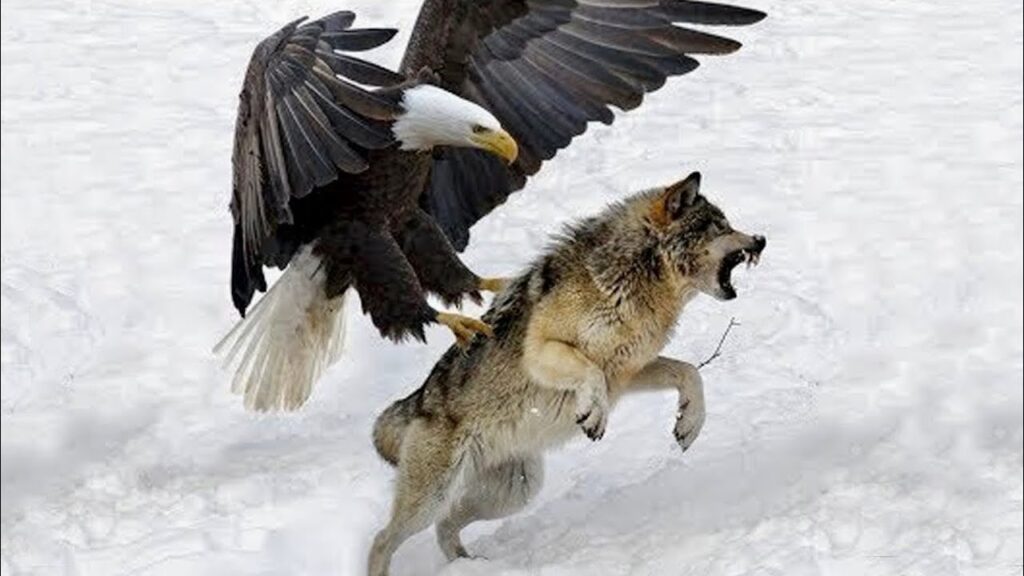
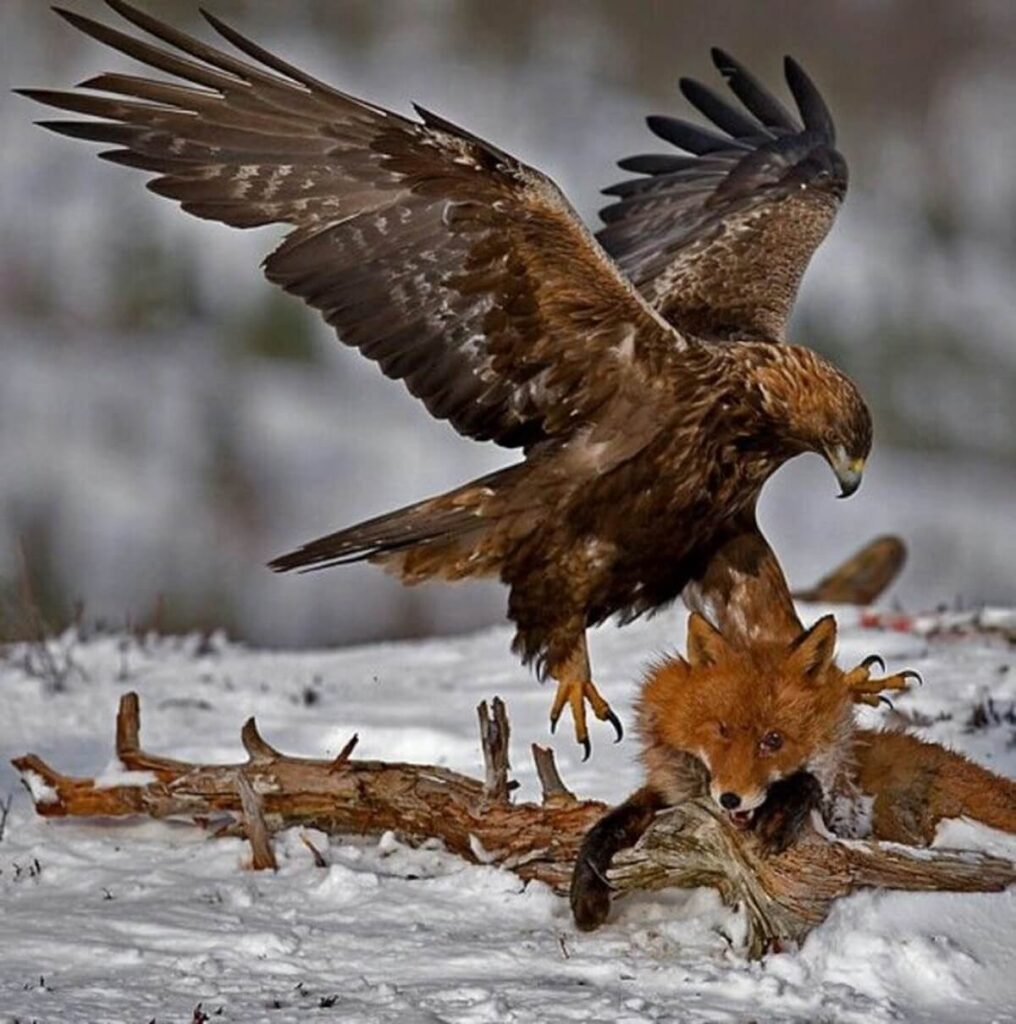
| Year 4–8 | Peak working years | Eagle takes red fox, hare, and occasionally young wolf; she is by now the apex partner in the family’s pastoral year |
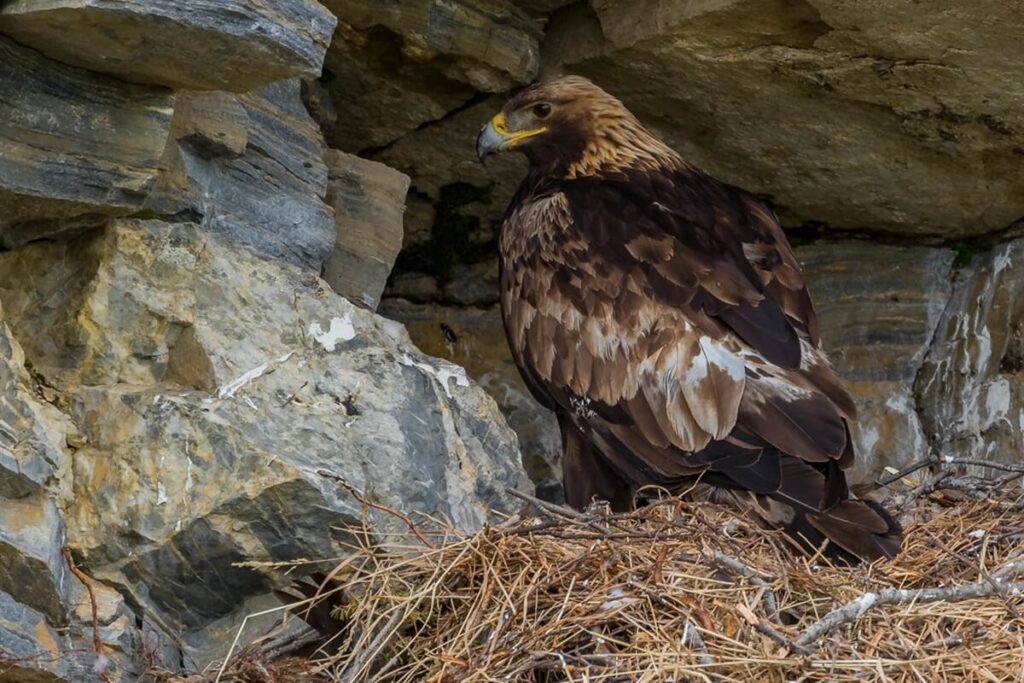
| Year 5–10 | Release | Hunter brings her back to a cliff territory in early spring and removes her jesses; she returns to wild breeding |
The rituals woven through this arc — feeding her the heart and liver of the first kill, naming her in formal ceremony, sharing milk with the bird at festivals — all reinforce the sense that the human is the junior partner in a sacred relationship, not the bird’s owner.
The Release Ritual: Returning the Eagle to the Wild
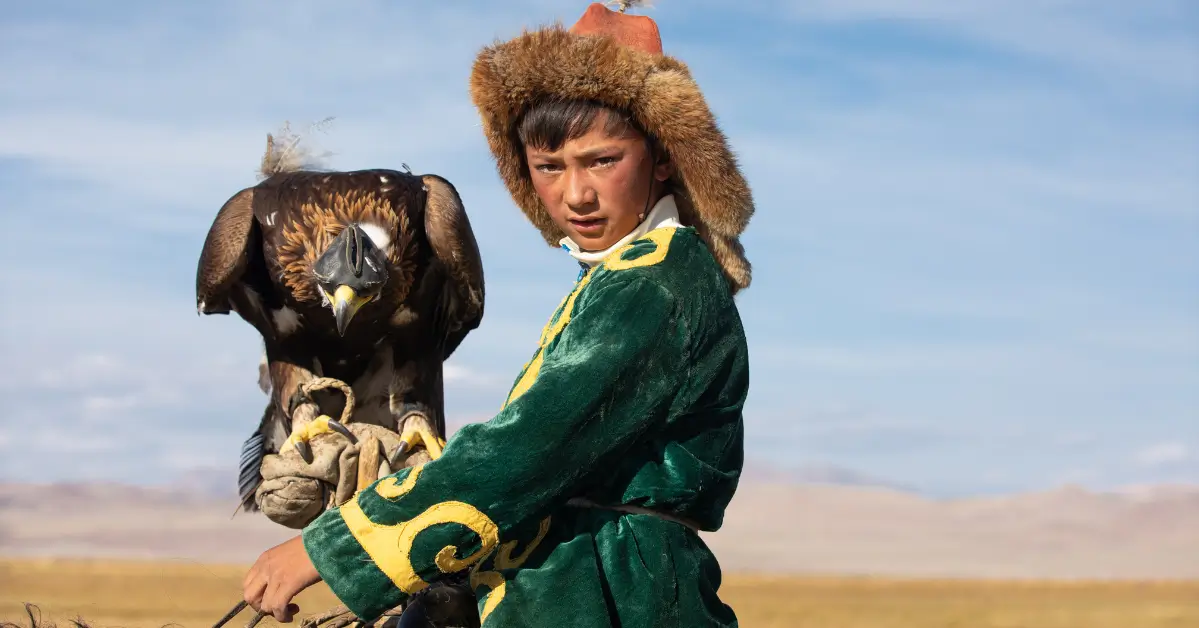
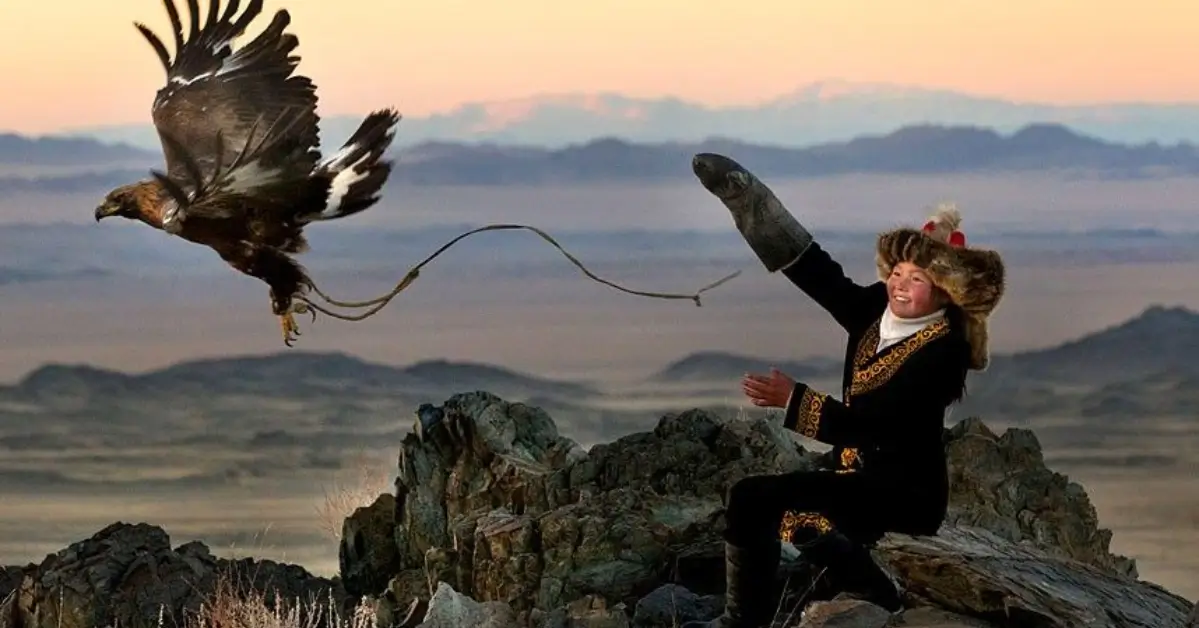
The most spiritually significant moment in the entire tradition is the moment a hunter ends the partnership and lets his eagle go. This usually happens after 5 to 10 hunting seasons, when the bird has reached breeding age and her wild instincts begin to outweigh her bond to the camp.
The release is not casual. It is timed to early spring, when wild eagles are pairing for the breeding season, and it is held in a place close to where the bird was originally taken — often a cliff in the same valley. The hunter typically:
- Fasts the eagle slightly so she will hunt for herself within a day
- Removes her jesses and hood without ceremony, so she experiences the moment as ordinary
- Sometimes leaves a freshly killed sheep or fox at the release site as a final meal
- Walks away without looking back, in keeping with the belief that meeting her eyes again would draw her into following him
This act has ecological as well as spiritual weight. Because every working female is returned to the breeding population, the wild golden eagle population in the Mongolian Altai is supplemented, not depleted by the tradition — one of the rare cases where centuries-old human use has been functionally sustainable. The Altai Berkut population (Aquila chrysaetos daphanea) remains stable at densities among the highest in Asia.
Eagles in Kazakh Oral Epic, Art, and Clothing
Beyond the working partnership, eagle imagery saturates Kazakh material culture in the Altai:
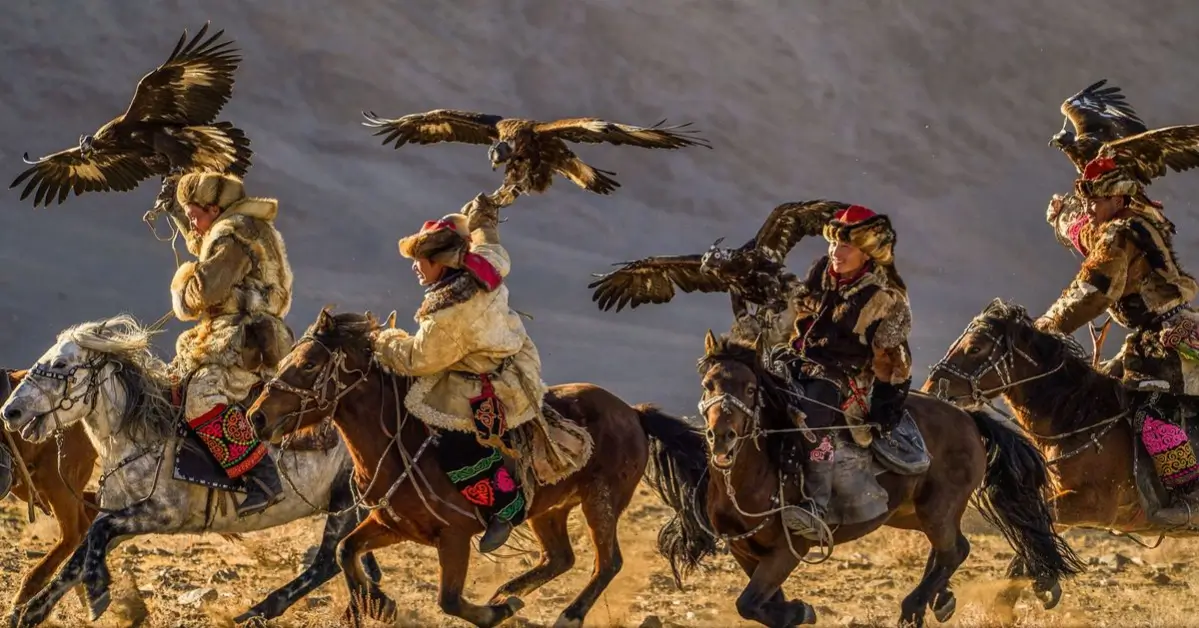
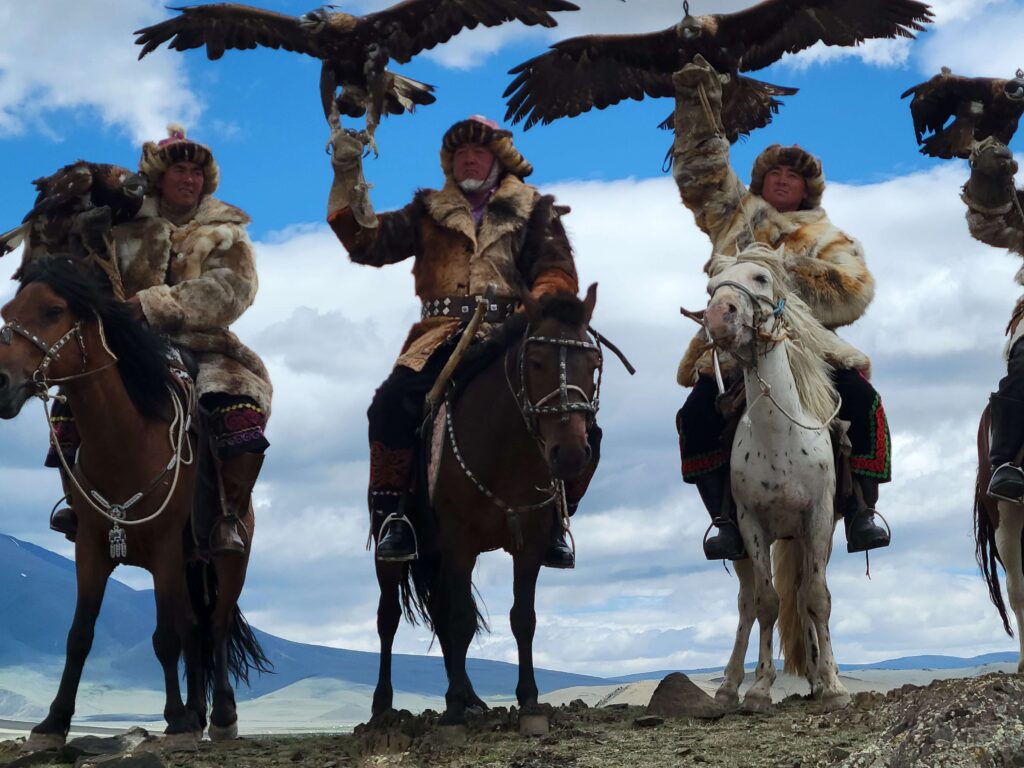
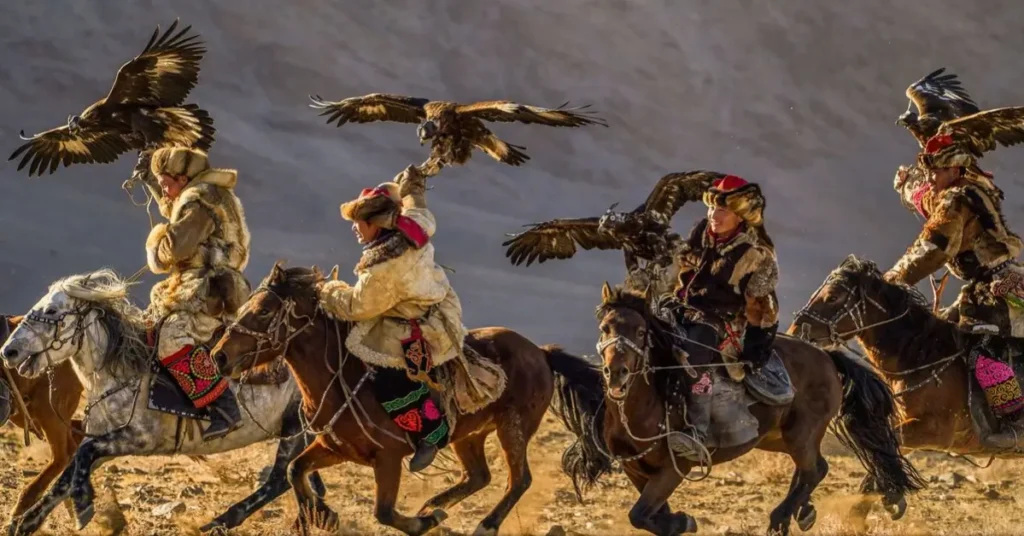
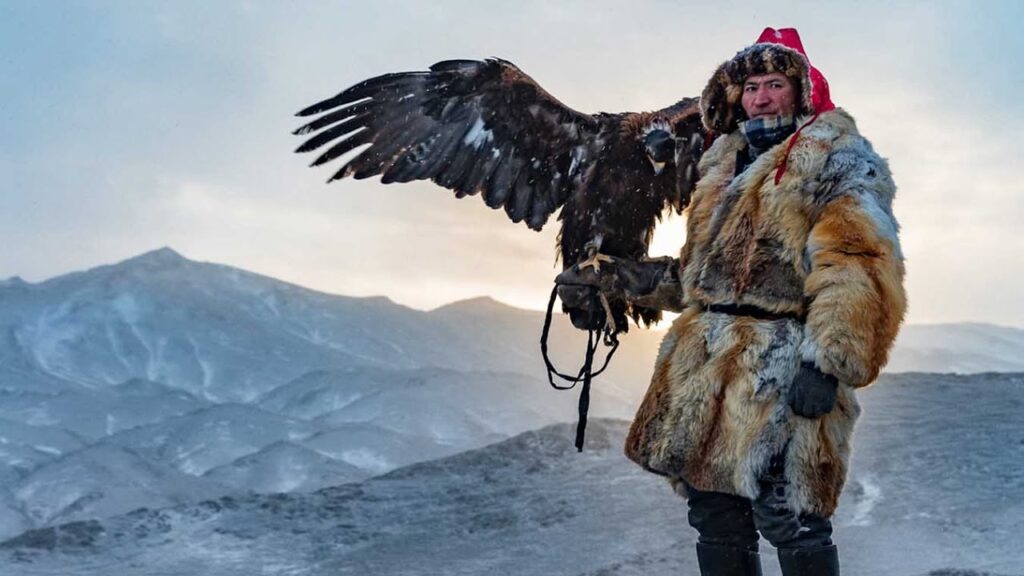
- Clothing — Hunters wear coats trimmed in fox fur taken with their own eagles; the value of the coat carries the prestige of the partnership. See more in our guide to traditional garments.
- Music — The two-stringed dombyra repertoire includes pieces composed in honour of named eagles, performed at festivals and family gatherings.
- Naming — Eagles are given individual names (often referencing colour, temperament, or a memorable hunt) and these names enter family memory the way a horse’s or a dog’s would in other cultures.
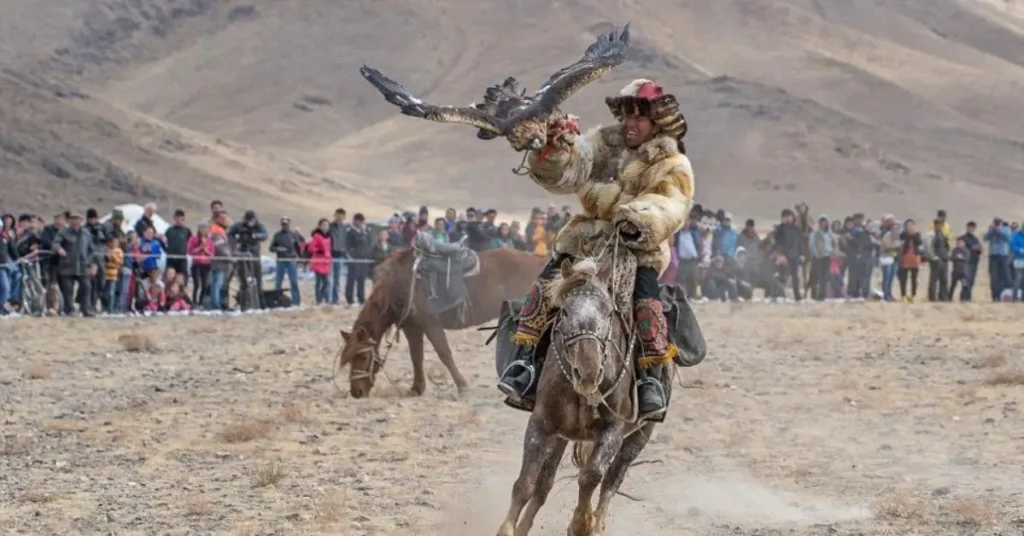
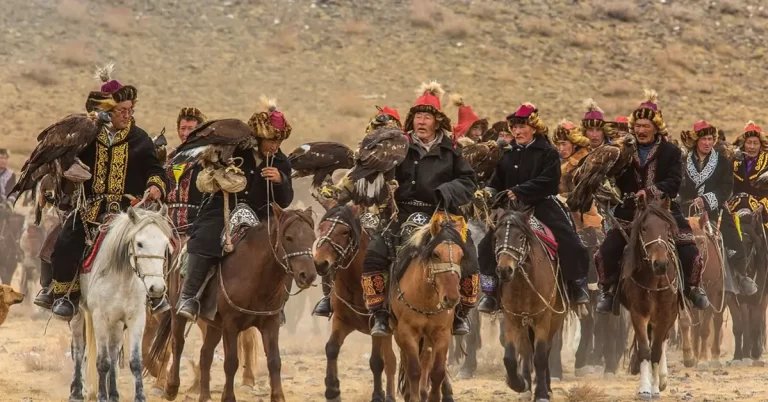
- Festivals — Annual events such as the Sagsai Eagle Festival and the larger Golden Eagle Festival in Ölgii showcase the spiritual public face of the tradition: the eagle held aloft on the gloved fist, the hunter in fox-fur regalia, the audience of three generations watching.
- Funerary practice — In some Altai families, when a working eagle dies, she is buried rather than skinned for parts — a practice that mirrors the burial of a respected family member.
These elements together signal something important: the eagle is treated as a cultural collaborator, not a tool. The bird shapes how a hunter dresses, what music his family makes, what his children grow up imitating, and how the surrounding nomadic community recognises his standing.
How the Spiritual Tradition Survives in Modern Mongolia
The Kazakh eagle-hunting practice is internationally recognised as a living human heritage. Falconry was first inscribed on UNESCO’s Representative List of the Intangible Cultural Heritage of Humanity in 2010 and broadened in 2021 to include Mongolia among the practising states.
Three forces sustain the spiritual practice today:
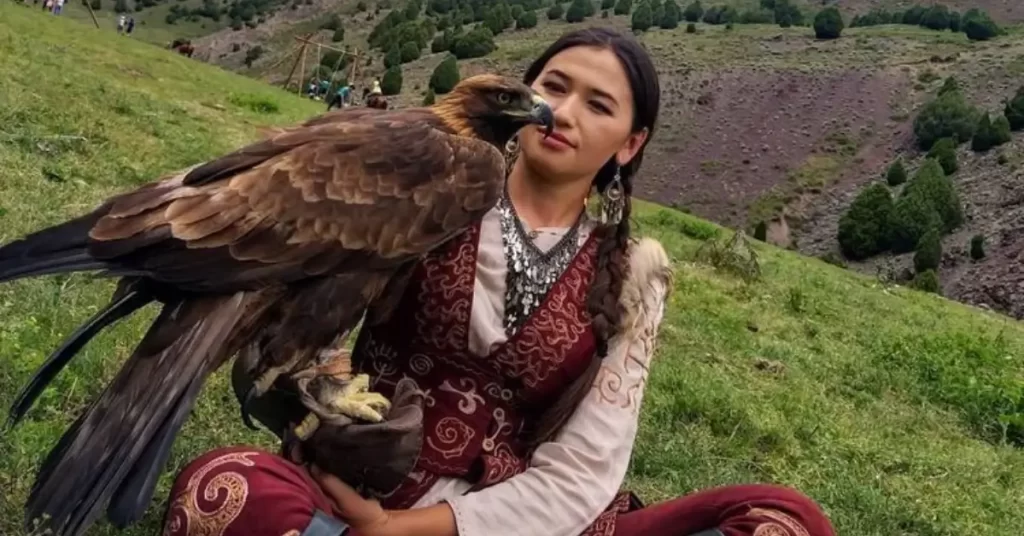
1. Family transmission. The skills, vocabulary, and ritual all move within Kazakh families — usually from father to son or, increasingly, father to daughter. A 2010 survey estimated roughly 400–500 active berkutchi in Bayan-Ölgii Province, with the next generation (under 30) numbered in the low hundreds.
2. Festival economy. Annual eagle festivals around Ölgii draw international visitors and provide both income and visibility. Without the festivals, demographic pressure on remote pastoral families would have erased much of the tradition by now.
3. State recognition. Mongolia recognises licensed eagle hunting under the 2000 Law on Fauna and protects the right of Kazakh families to take juveniles for training, a legal carve-out that exists almost nowhere else for golden eagles.
The result is fragile but functional: a centuries-old spiritual partnership preserved largely because the wider world finally noticed it, and because the Kazakh berkutchi families chose to share it on their own terms.
How Visitors Can Witness the Tradition Respectfully
If you want to experience the spiritual side of Kazakh eagle hunting — not just photograph the spectacle — a few principles matter.
- Visit in winter, not just at the festival. Festivals are wonderful, but a quiet morning in a hunter’s ger, watching him prepare his eagle for a hunt, is where the real relationship is visible.
- Ask before photographing the eagle close up. The bird is on a working day; flash and drone proximity are unwelcome and culturally rude.
- Listen for names. When a hunter calls his eagle by name, he is signalling the depth of the bond. That name is family memory.
- Accept the food and tea offered. Sharing milk-tea, fried bread, and meat in a hunter’s ger is the social architecture in which everything else happens.
- Travel with a Kazakh-speaking local guide. Direct independent travel into hunter family camps is impractical and culturally awkward; the relationships have to be set up by someone the family trusts.
Practical winter visits are most easily organised through guided tours that include ger-camp stays. Our Mongolian Eagle Hunters tour and a tour built around the Sagsai Eagle Festival are both designed around this respectful, slow-paced approach to the tradition.
Suggested Tours:
Suggested Blogs:
Golden Eagle Photography: How to Shoot Wild Eagles, Hunters and the Festival
Golden eagle photography rewards preparation more than luck. For birds in flight, start at 1/2500s, f/6.3, auto-ISO capped at 3200,…Eagle Festival Packing List 2026: What to Wear in Olgii’s October Cold
The Mongolia Eagle Festival in Bayan-Ölgii runs in late September and early October at elevation 1,710 metres, where October average…Sagsai vs Golden Eagle Festival 2026: Which Mongolia Eagle Festival Should You Attend?
Mongolia hosts two distinct Kazakh eagle festivals each autumn in Bayan-Ölgii Province, the country’s western Kazakh-majority region. The Sagsai Golden…




Why are golden eagles considered sacred to Kazakh nomads?
Because in the older Tengrist worldview that still shapes Kazakh culture in the Altai, eagles were viewed as messengers of the supreme sky god Tengri. Soaring high into the upper world, they linked humans to the divine. Even after most Kazakhs adopted Islam, the spiritual respect for the bird remained — visible today in naming traditions, release rituals, and the language hunters use about their eagles.
What is the Samruk legend?
Samruk is a mythical golden bird in Kazakh and broader Turkic oral epic, often depicted as a golden eagle that brought light to a darkened world. She nests in the Tree of Life (Bäyterek) and lays a renewing golden egg each year. The legend ties together themes of light, rebirth, and the cosmic role of the eagle in connecting the upper, middle, and lower worlds.
Why do Kazakh hunters release their eagles back to the wild?
After five to ten hunting seasons, when the eagle reaches breeding age, the berkutchi releases her back to a wild cliff territory. Spiritually, the act honours the eagle’s freedom and her place in the sky-god’s domain. Practically, it means every working bird returns to the breeding population, keeping the wild Altai golden eagle population stable.
Is eagle hunting protected as cultural heritage?
Yes. Falconry — including the Kazakh eagle-hunting tradition — is inscribed on UNESCO’s Representative List of the Intangible Cultural Heritage of Humanity, originally in 2010 and expanded in 2021 to include Mongolia among the practising states. Mongolia also licenses traditional eagle hunting under its 2000 Law on Fauna.
How many active eagle hunters are left in Mongolia?
Roughly 400–500 active berkutchi practise in Bayan-Ölgii Province, with fewer than 200 under the age of 30. The tradition is under demographic pressure but is currently stable, sustained by family transmission, the festival economy in Ölgii, and growing international interest in Kazakh nomadic culture.
Can outsiders attend a real eagle hunt?
Yes, but typically only through licensed tour operators with established relationships in Kazakh hunter families. Independent visits are impractical and culturally awkward. The best months for the actual hunt are December and February; the festivals fall in late September and early October.