
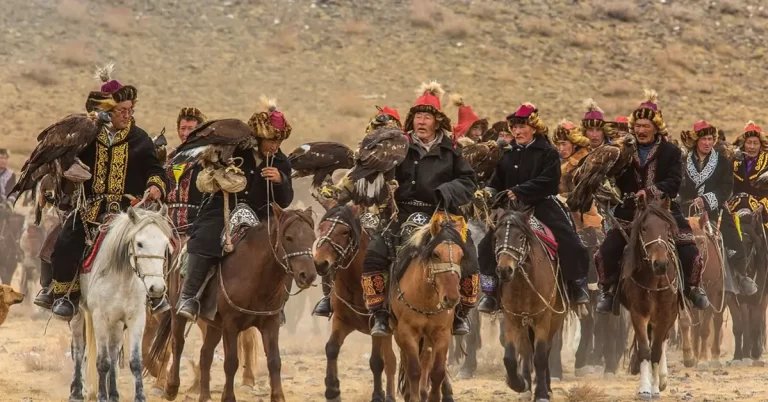
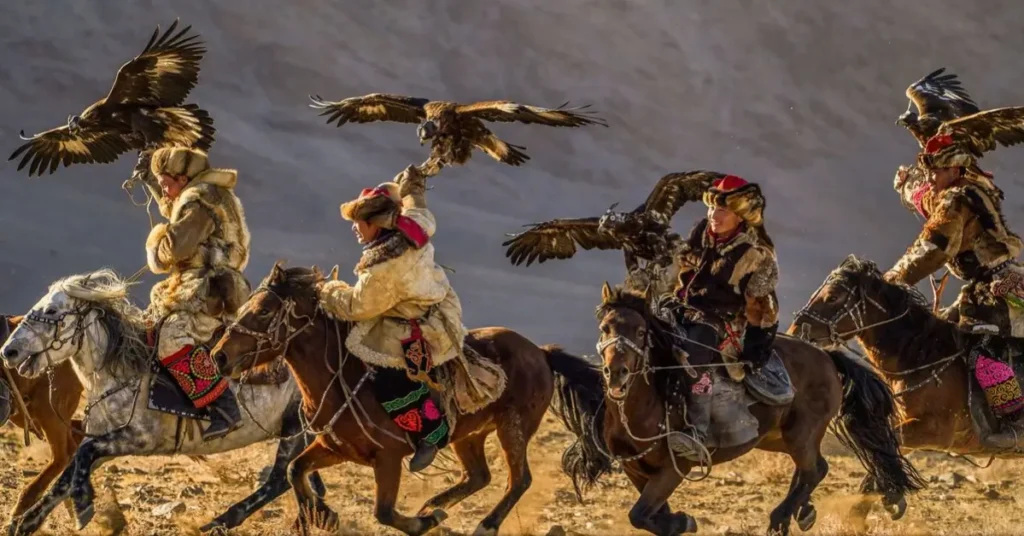
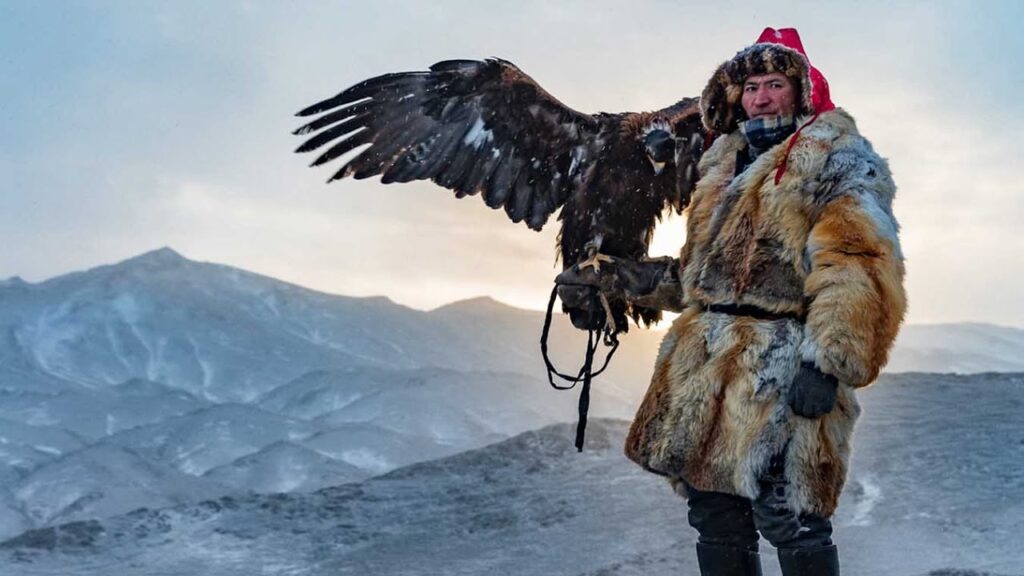
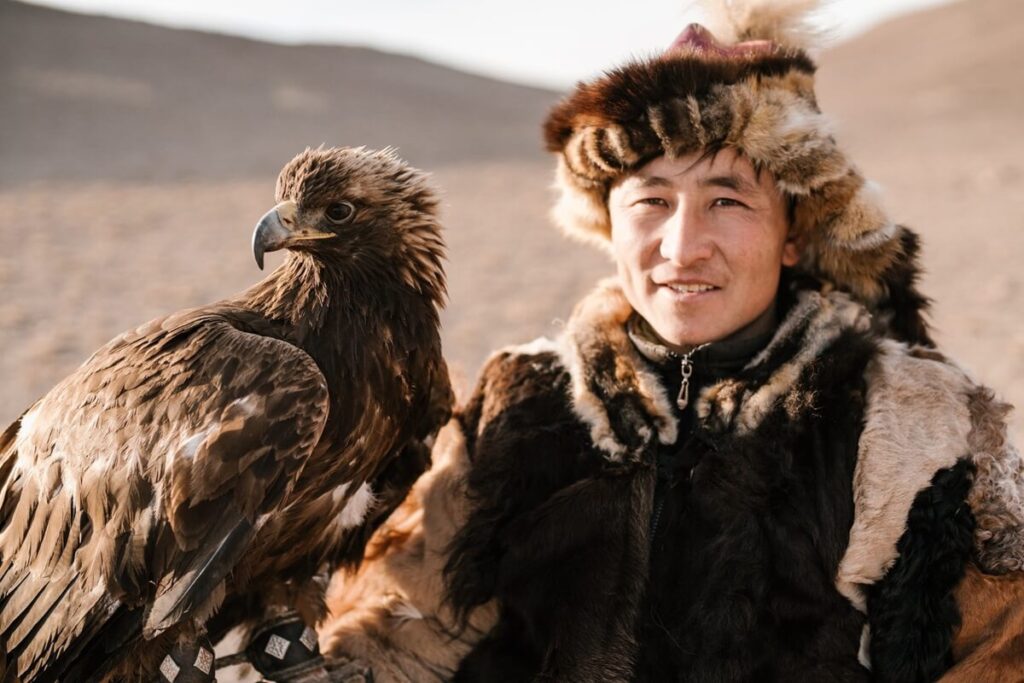
After years of hunting partnership in the Altai Mountains, a Kazakh berkutchi (eagle hunter) traditionally releases his trained female golden eagle back to the wild. The release is not retirement — it is a deliberate act. The eagle is returned to the cliffs while still young enough to breed, blending spiritual respect for her freedom with a pragmatic conservation instinct passed down through generations of hunters in Bayan-Ölgii province. Around 250 active berkutchi practise this tradition today.
Key Takeaways
- The release ritual is a deliberate end to a years-long partnership, not abandonment
- Kazakh hunters work almost exclusively with female golden eagles, which are 26 to 37 percent heavier than males and stronger hunters of large prey
- The eagle is released while still in her reproductive prime so she can return to the wild breeding population
- The practice is part of UNESCO’s Intangible Cultural Heritage of Falconry, inscribed in 2010 and expanded in 2021 to 24 States Parties including Mongolia and Kazakhstan
- An estimated 250 active berkutchi remain in Bayan-Ölgii province, the heart of Kazakh eagle hunting in Mongolia
- Wild golden eagles can live 30 years or more, giving a released bird a long second life
What the Eagle Release Ritual Actually Is
The release ritual marks the formal end of the working partnership between a Kazakh hunter and his trained golden eagle. It is not a single fixed ceremony with rigid steps — practice varies by family, region within Bayan-Ölgii, and the hunter’s age. What is consistent is the intent: the eagle is returned to the wild while she is still strong, healthy, and capable of finding a mate.
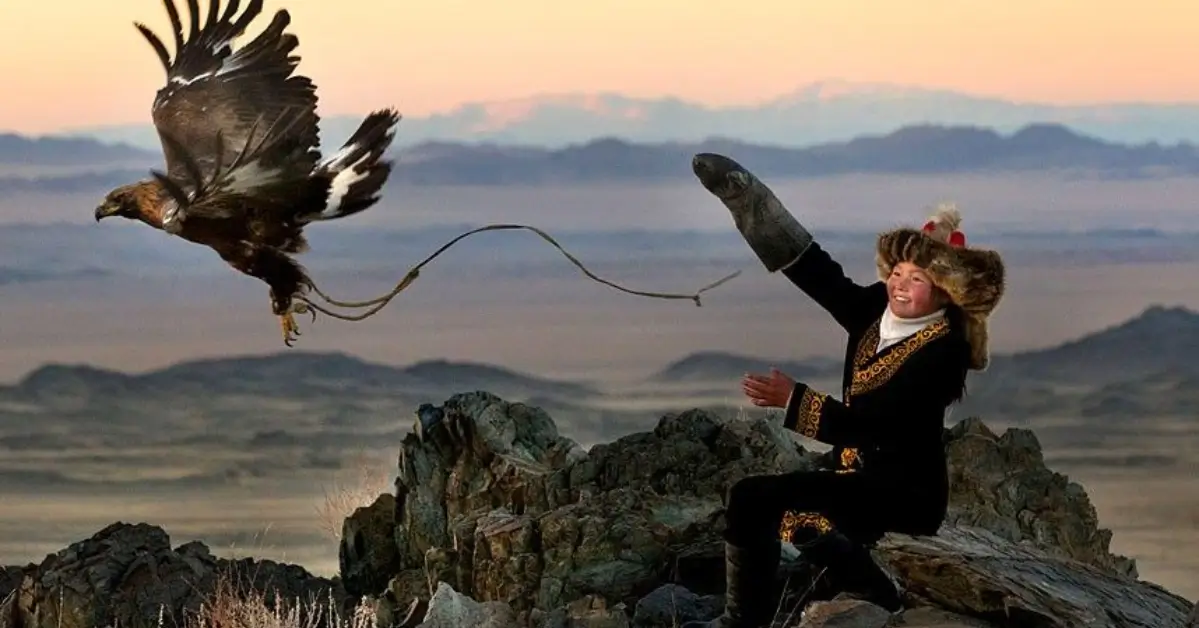
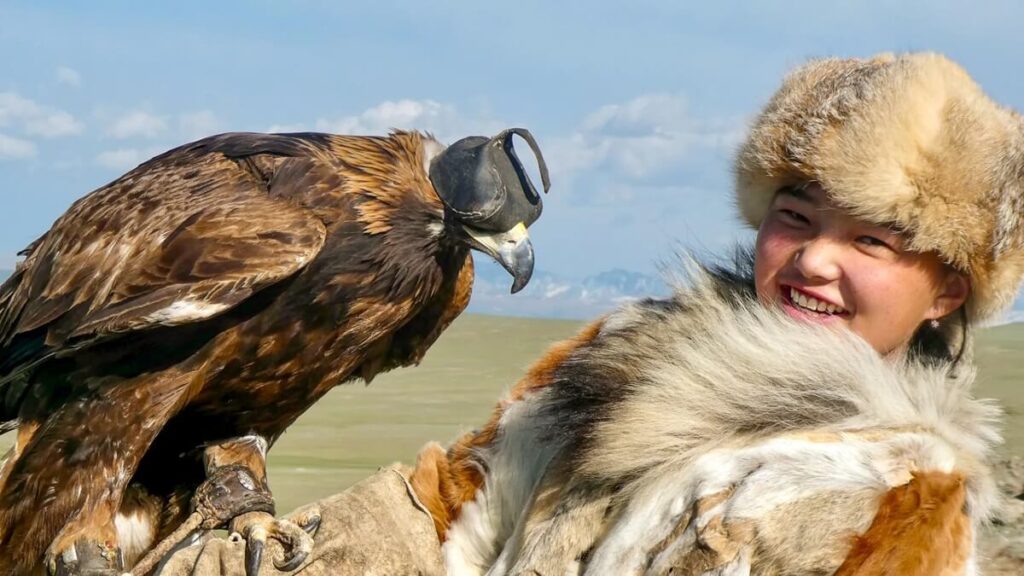
The hunter typically rides into the high country, often near the cliffs where the bird was originally taken as a chick. He removes her hood and jesses (the leather straps used to tether her on the glove), recites prayers or words of farewell, and lets her go. Many hunters describe leaving a final meal of fresh meat at the release site — a parting gift from a hunter who has fed his bird daily for years.
The exact timing — how many years into the partnership the release happens — depends on the eagle’s condition, the hunter’s circumstances, and family tradition. But the underlying philosophy holds across the practice: an eagle is borrowed from the wild, not owned by the hunter.
Why Female Golden Eagles
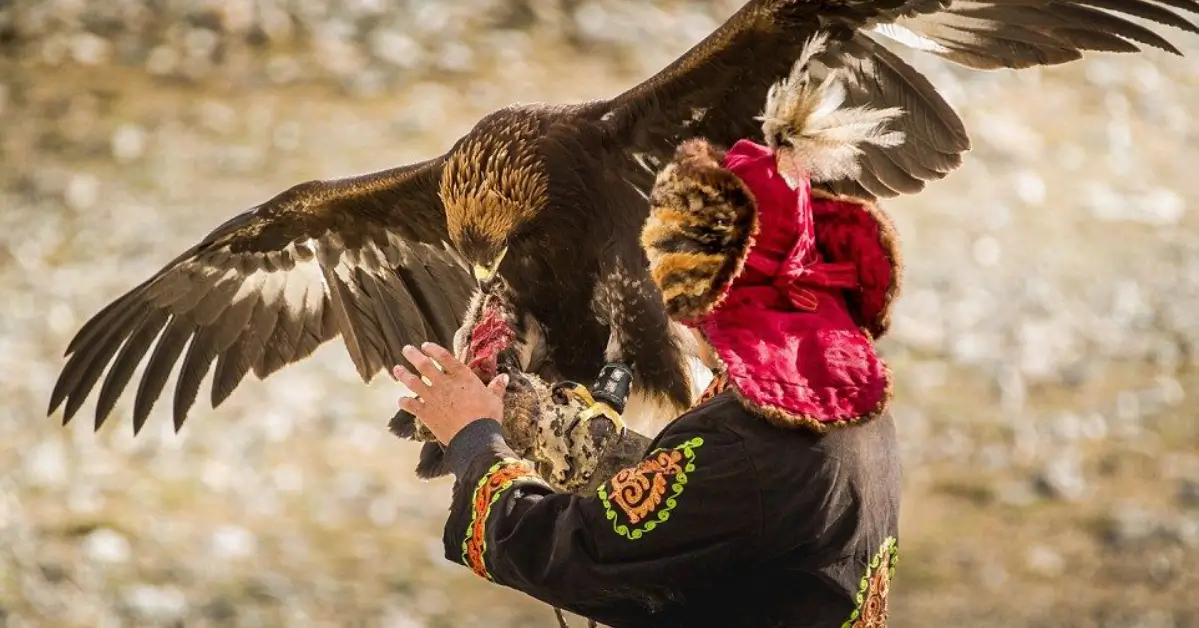
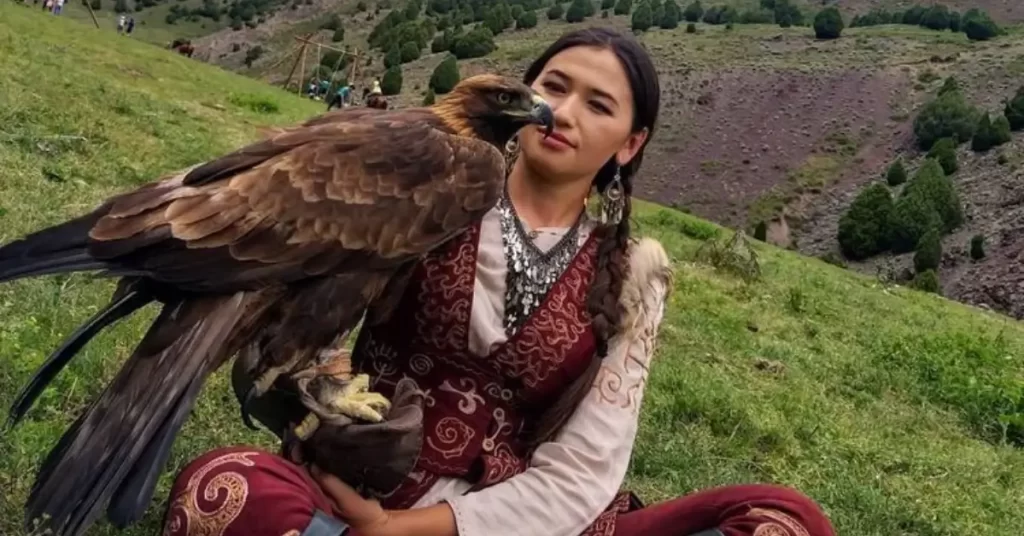
Walk into any berkutchi household and the eagle perched on the wooden T-stand will almost certainly be female. This is not preference — it is biology.
Female golden eagles are noticeably larger than males, and the gap matters when the prey is fox or wolf rather than rabbit.
| Subspecies | Female weight advantage | Female wing length advantage |
|---|---|---|
| Himalayan golden eagle (large) | ~37% heavier than males | ~9% longer wings |
| Japanese golden eagle (small) | ~26% heavier than males | ~6% longer wings |
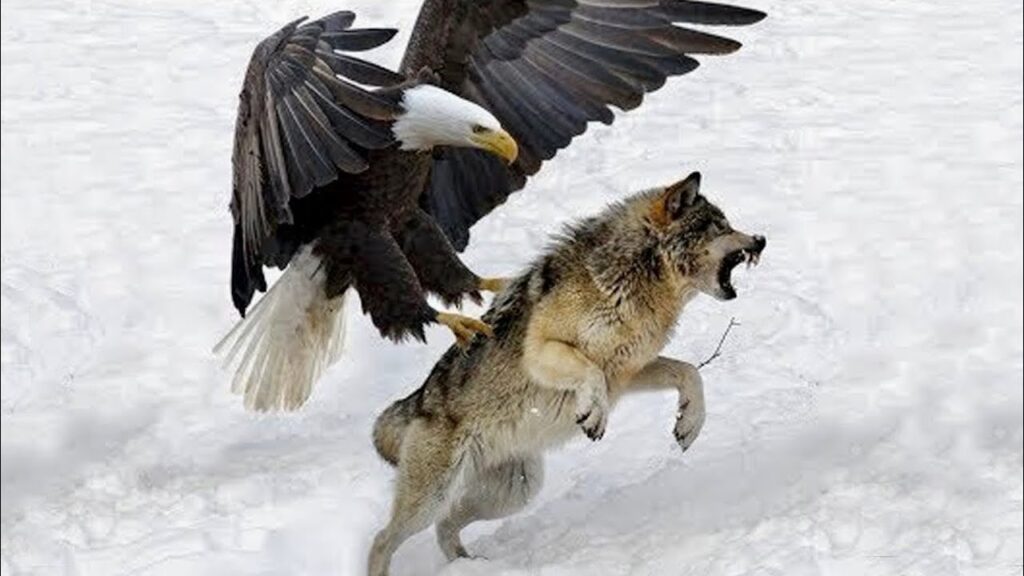
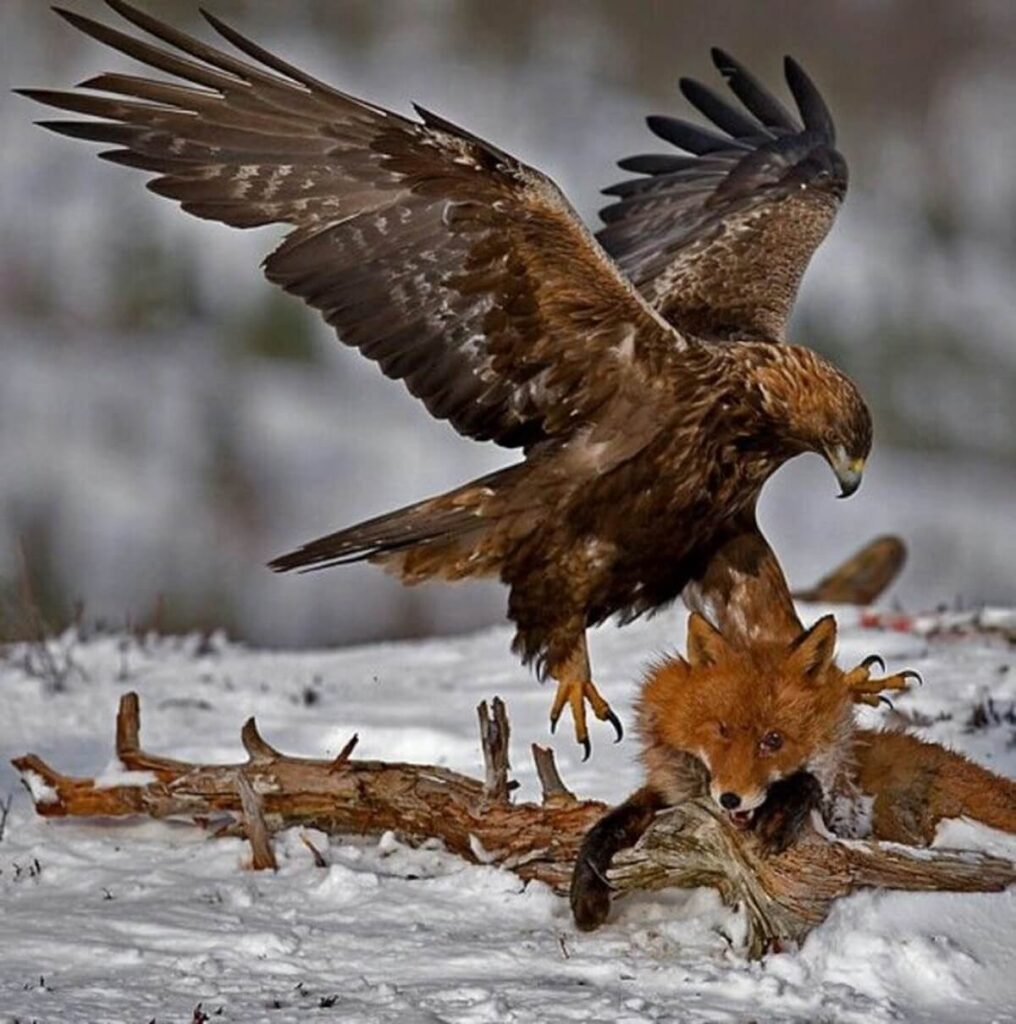
Greater body mass and wing area mean greater force in the strike — a critical advantage when the quarry includes foxes, hares, marmots, and on rare and famous occasions wolves.
The Britannica entry on falconry confirms the practice: in Kazakhstan, Kyrgyzstan, and Mongolia, golden eagles are flown at wolves, foxes, and gazelles. A male eagle would struggle with prey of that size. The female has the bone structure and muscle mass that the work demands.
There is also a cultural dimension. The Kazakh word for an eagle hunter is bürkitshi, derived from bürkit, the Kazakh name for the golden eagle. The bird at the centre of the tradition is, by long custom and by physical capability, the female.
How the Partnership Begins: The Eaglet at the Nest
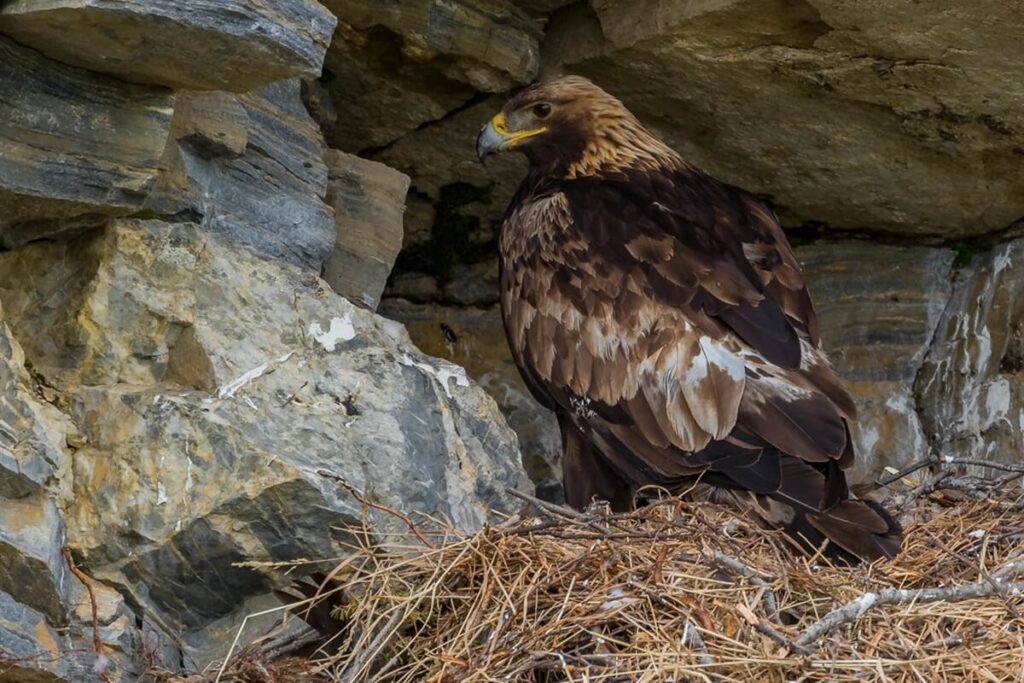
The relationship that ends with a release ceremony begins, in most cases, at a cliff nest. Falconry tradition distinguishes between an eyas (a young hawk taken as a nestling from the wild) and a passager (a bird trapped in its first year after fledging). Kazakh hunters take both, though the eyas — taken before she can fly — is the more common starting point because she imprints on her keeper from the earliest days.
The hunter or his apprentice climbs to the nest, almost always a stick-built eyrie on a cliff ledge or high rock outcrop, and lifts a single eaglet. By tradition only one bird is taken from any nest, leaving siblings and breeding adults undisturbed. The mother eagle will continue to raise the remaining chick, and she will return to the same nest the following year — golden eagles are strongly site-faithful and reuse nests across decades.
The young bird is brought home and placed under constant human care. From this moment her diet, her sleep, her exposure to sound and movement, and her acceptance of the human glove all become the hunter’s daily responsibility.
The Years Between: Training, Hunting, and the Bond
Falconry training, in any tradition, rests on a single principle: weight management. The Britannica entry puts it plainly — the key to a hawk’s training is conditioning, which means finding the correct flying weight; an overweight hawk will be comparatively wild. A bird flown at the correct weight is sharp, focused, and willing to return to the lure.
For a Kazakh hunter, this means weeks of patient handling: feeding the eagle on the glove, accustoming her to noise and movement, then progressing to flights on a creance (a long lightweight training line), and finally to free flight. The first successful kill — a fox, a hare, sometimes a corsac fox in the snow — confirms that the bird is ready to hunt for real.
What develops during these years is harder to describe. Hunters speak of a partnership that is not pet-like and not master-and-tool either. The eagle is fed and sheltered by the hunter and in return she hunts at his command. She knows her keeper’s voice, recognises his horse, and returns to his glove from a kilometre away. UNESCO’s documentation of falconry notes that the practice is transmitted from generation to generation through mentoring within families or in training clubs — the bond between hunter and bird is one of the elements being safeguarded.
The Release: Timing, Reasoning, and Ceremony
A wild golden eagle can live a long time. The oldest known wild golden eagle was a bird banded in Sweden and recovered 32 years later; the oldest in North America was 31 years and 8 months; in captivity, one survived to 46 years. A bird taken from the nest as a chick could potentially work as a hunter for a decade and still have decades of wild life ahead of her.
This is the foundation of the release ritual. A hunter who keeps his eagle until she is too old to breed has effectively removed her from the wild gene pool for her entire reproductive life. A hunter who releases her while she is still strong gives her years to find a mate, raise eaglets, and add her bloodline back to the population the next generation of hunters will draw from.
The release itself is intimate rather than public. The hunter, sometimes accompanied by sons or apprentices, takes the eagle to a high place — often the same kind of cliff country she came from. He removes her hunting equipment, and in many accounts leaves a final meal of fresh meat as a farewell offering. He speaks to her, then watches her go.
For travellers who have only seen the spectacle of the Sagsai or Ulgii eagle festivals, this part of the tradition is almost invisible. It happens privately, on the hunter’s own timing, in his own country. But it is the part that makes the practice sustainable.
The Conservation Logic Embedded in Tradition
The release ritual functions as a working conservation rule, encoded in oral tradition long before modern wildlife science arrived in the Altai. Three features of the tradition combine to keep wild eagle populations stable:
- Only one chick is taken from any active nest, and the breeding adults are never harmed
- Only female birds are routinely taken, leaving male chicks to reach breeding age in the wild
- The trained female is returned to the wild while she is still in her reproductive prime
The result is a centuries-old practice that removes one female eagle from the wild for a fixed working span, then puts her back. Compared to historical falconry traditions in other parts of the world that often retained birds for life, the Kazakh model is unusually gentle on the wild population.
This is not a coincidence. Pastoral cultures that depend on a wild resource — the eagle, the wolf, the snow leopard, the migratory marmot — tend to develop rules that prevent the resource from collapsing. The release ritual is one of those rules in action.
UNESCO Recognition and the Modern Berkutchi
Falconry was inscribed on the UNESCO Representative List of the Intangible Cultural Heritage of Humanity in 2010, and the listing was expanded in 2021 to cover 24 States Parties — including both Mongolia and Kazakhstan. The recognition matters because it formalises what berkutchi families have always known: this is heritage worth safeguarding.
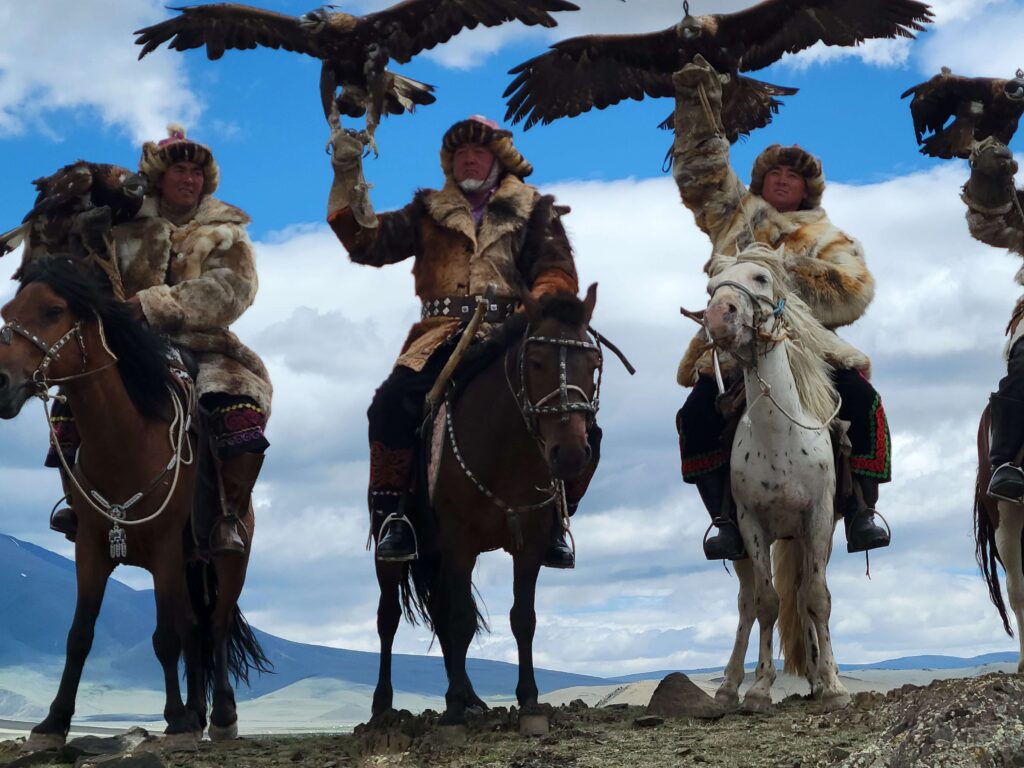
The number of practitioners is small. Wikipedia’s overview of falconry notes a little over 300 active eagle falconers in Central Asia, with around 250 in western Mongolia and roughly 50 in Kazakhstan. The Berkutchi entry estimates around 250 in Bayan-Ölgii province specifically. These are not large numbers, and the next generation of hunters faces the same urban migration and education-driven shifts that affect every nomadic tradition in the region.
The release ritual is one of the practices that visiting researchers, documentary makers, and cultural-heritage officials specifically cite when explaining why the Kazakh model is worth protecting. It is, simply, a clear example of a working culture that takes from nature only what it returns.
What This Tradition Means for Visitors
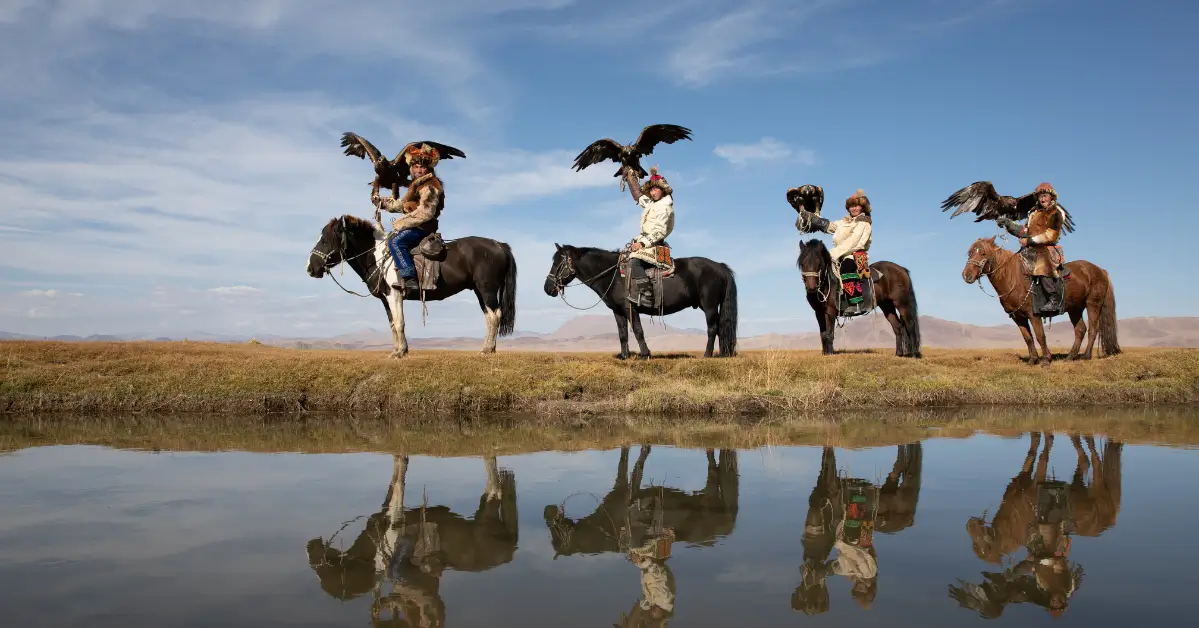
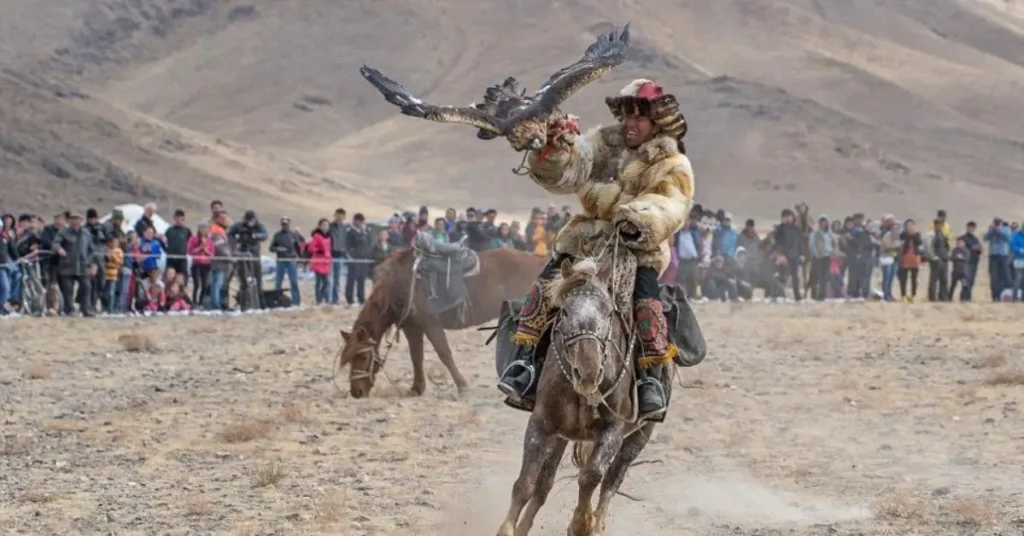
For travellers who come to Bayan-Ölgii to meet a berkutchi family — at the Sagsai festival in September, the Ulgii Golden Eagle Festival in October, or on a private homestay in winter — the release ritual is the part of the practice you are least likely to see. It happens in the hunter’s own country, on his own schedule, and rarely in front of cameras. But knowing it exists changes what you are watching when an eagle hunts on the festival grounds.
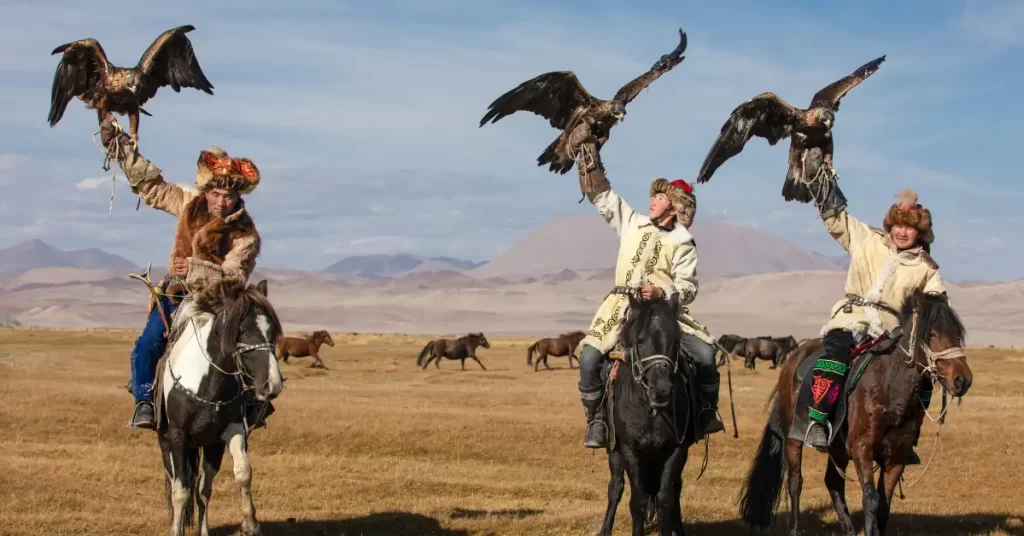
You are not watching a captive performance. You are watching a working partnership that began at a cliff nest, will continue for some years yet, and will end with the bird returning to those same cliffs to raise her own chicks. The eagle on the hunter’s glove is on loan from the wild.
If you are planning a trip to meet the eagle hunters, the most respectful thing a visitor can do is treat the eagle as the family treats her — with the awareness that she is not a possession. Avoid pressuring hunters or interpreters for “selfie” handling shots beyond what is offered, and choose tour operators who work with established berkutchi families on terms set by the hunters themselves.
For travellers planning to witness the tradition firsthand, our Eagle Hunters Adventure places you with active berkutchi families in Bayan-Ölgii, while the Altai Eagle Festival tour and Golden Eagle Festival tour cover the two main competition gatherings.
Suggested Tours:
Suggested Blogs:
Golden Eagle Photography: How to Shoot Wild Eagles, Hunters and the Festival
Golden eagle photography rewards preparation more than luck. For birds in flight, start at 1/2500s, f/6.3, auto-ISO capped at 3200,…Eagle Festival Packing List 2026: What to Wear in Olgii’s October Cold
The Mongolia Eagle Festival in Bayan-Ölgii runs in late September and early October at elevation 1,710 metres, where October average…Sagsai vs Golden Eagle Festival 2026: Which Mongolia Eagle Festival Should You Attend?
Mongolia hosts two distinct Kazakh eagle festivals each autumn in Bayan-Ölgii Province, the country’s western Kazakh-majority region. The Sagsai Golden…





Why do Kazakh eagle hunters release their eagles back to the wild?
The release returns the bird to the wild breeding population while she is still in her reproductive prime. Wild golden eagles can live 30 years or more, so an eagle released after a working partnership has decades of wild life ahead of her, including time to raise eaglets that contribute to the population future hunters will draw from. The reasoning combines spiritual respect for the eagle’s freedom, conservation pragmatism, and centuries of pastoral wisdom.
How long does a Kazakh hunter keep his eagle before releasing her?
The exact span varies by hunter, family tradition, and the bird’s condition. What is consistent across the practice is that the eagle is returned while still strong and capable of breeding, not kept until old age. Decisions are made based on the bird’s hunting performance and physical health, not a fixed calendar.
Why are only female golden eagles used for hunting?
Female golden eagles are 26 to 37 percent heavier than males with longer wings, giving them the strength to take large prey such as foxes, hares, marmots, and occasionally wolves. The Kazakh practice has selected for female birds for centuries, both for their hunting power and because their physical size matches the work being asked of them.
Is the release ritual a public ceremony or private?
It is private. Unlike the festival competitions in Sagsai and Ulgii, the release happens in the hunter’s home country, often near the cliffs where the bird was originally taken. Family members or apprentices may attend, but it is not a tourist spectacle and is rarely documented on camera.
How many active eagle hunters remain in Mongolia today?
Around 250 active berkutchi practise the tradition in Bayan-Ölgii province, the heart of Kazakh eagle hunting in Mongolia. A further 50 or so practise in Kazakhstan, with smaller numbers in Kyrgyzstan and western China.
Is Kazakh eagle hunting recognised as cultural heritage?
Yes. UNESCO inscribed Falconry as Intangible Cultural Heritage of Humanity in 2010, and expanded the inscription in 2021 to cover 24 States Parties including Mongolia and Kazakhstan. The release ritual is one of the practices that supports the inscription’s emphasis on safeguarding the relationship between bird and falconer.