
Eagle Vision vs. Human Vision – The comparison between eagle vision and human vision offers a fascinating glimpse into the different ways species have adapted to their environments.
While humans are considered to have exceptional visual capabilities, especially in terms of color perception and focus, eagles possess vision that far surpasses human abilities in terms of sharpness and distance.
Understanding these differences highlights the evolutionary adaptations that allow each species to thrive in its respective ecological niche.
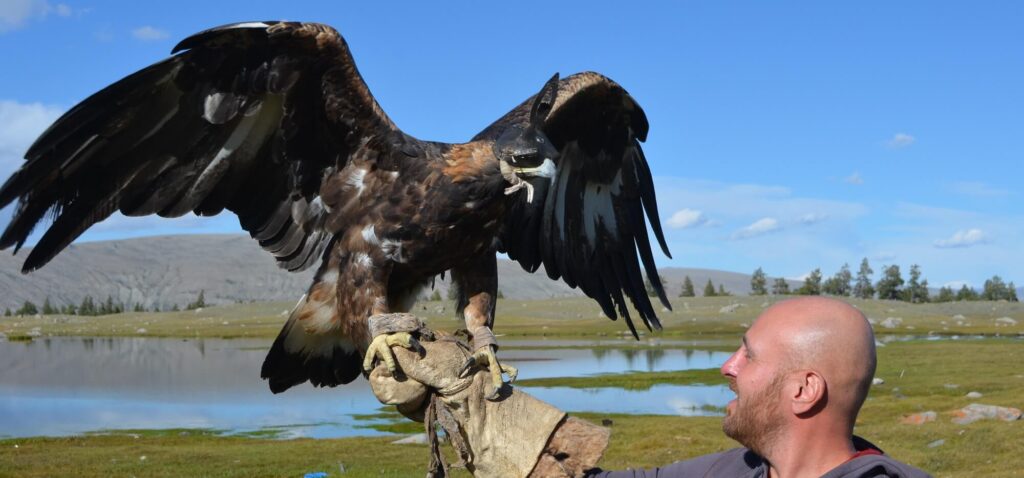
We offer you GOLDEN EAGLE FESTIVAL PHOTOGRAPHY TOUR. Come and enjoy the stunning landscape that is covered with ancient mountains, rivers, and Mongolian history. Join us to watch a great festival with truly great hunters! 🤩🤩
Visual Acuity and Sharpness
🦅 Want to experience this in person? Join our Live with eagle hunter families (year-round) with local Kazakh guides — small groups, authentic experience, 5.0 stars on TripAdvisor.
One of the most significant differences between eagle vision and human vision is visual acuity, which refers to the sharpness or clarity of vision.
Eagles, especially those in the genus Aquila such as the golden eagle, have a visual acuity that is estimated to be 4 to 8 times greater than that of humans. This means that an eagle can see from a distance of 1.6 kilometers what a human with perfect vision can see from only 200 meters away.
This incredible sharpness is due to the high density of photoreceptor cells, known as cones, in the eagle’s retina. Eagles have about 1 million cones per square millimeter, compared to humans who have about 200,000.
This high density allows eagles to detect even the smallest movements from great distances, which is crucial for hunting.

Field of View
Another significant difference is the field of view. Eagles have a broader field of view compared to humans, which is vital for spotting prey from high altitudes.
While humans have a field of view of about 180 degrees, eagles can see almost 340 degrees without moving their heads. This wide field of view allows them to monitor a vast area while in flight, making it easier to detect prey or potential threats.
Eagles achieve this wide field of view through their large eyes, which are proportionally much larger than human eyes in relation to their body size. Additionally, their eyes are positioned more towards the sides of their heads, further expanding their peripheral vision.

Color Vision and Perception
When it comes to color vision, both humans and eagles have excellent capabilities, but there are notable differences in the spectrum of colors each can perceive.
Humans have three types of color receptors (cones) in their eyes, which allow them to see the three primary colors: red, green, and blue. Eagles, on the other hand, possess four types of cones, with the additional cone being sensitive to ultraviolet light.
This means that eagles can see a broader range of colors, including those in the ultraviolet spectrum, which are invisible to humans. This ability is advantageous for hunting, as it allows eagles to see the urine trails of small mammals, which reflect ultraviolet light, making it easier for them to locate prey.

Focus and Depth Perception
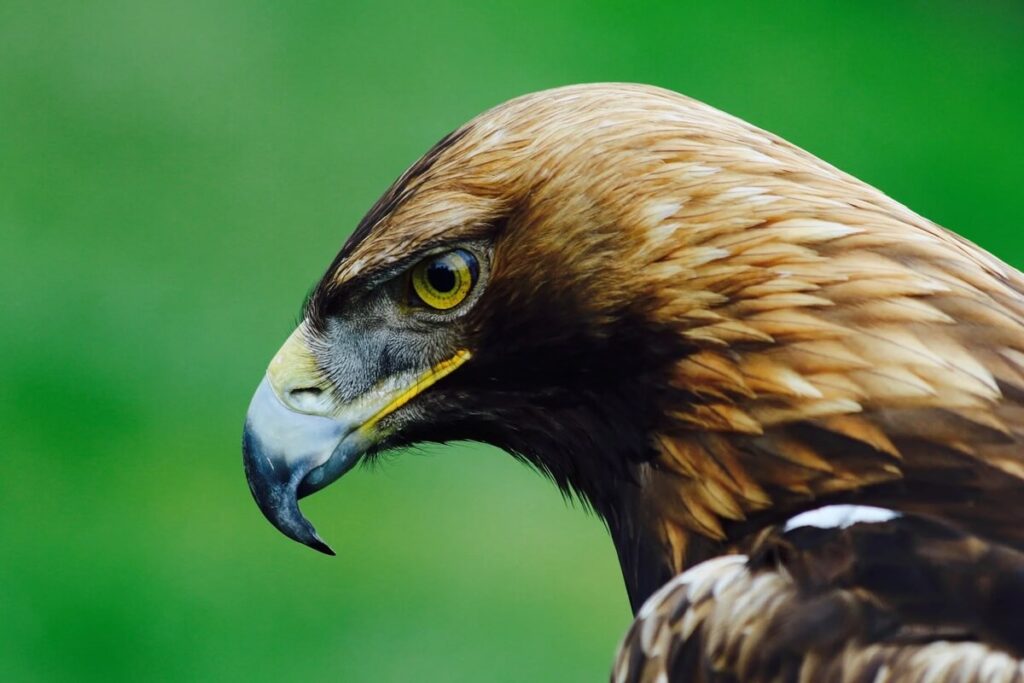
Eagles also excel in focus and depth perception. They have the ability to shift focus quickly from distant objects to close ones, a feature that is critical during high-speed dives when hunting. This is partly due to the structure of their eyes, which includes a deep fovea, a specialized area of the retina responsible for sharp central vision.
Eagles have two foveae in each eye, compared to humans who have only one, giving them bifocal vision. This allows them to focus simultaneously on objects at different distances—another adaptation that enhances their hunting prowess.

Evolutionary Adaptations
The differences between eagle vision and human vision are deeply rooted in evolutionary adaptations. Eagles have evolved to be apex predators, relying on their vision to hunt and survive.
Their sharp vision, wide field of view, and ability to perceive ultraviolet light have all been honed through millions of years of evolution to maximize their effectiveness as hunters. In contrast, human vision has evolved to support activities such as foraging, tool-making, and social interaction.
While humans may not have the same level of visual acuity or color perception as eagles, their vision is highly adapted to a different set of needs, including detailed close-up work and the recognition of a wide range of facial expressions and social cues.

In summary, eagle vision is characterized by remarkable sharpness, a wide field of view, enhanced color perception, and exceptional focus, all of which are adaptations that make them efficient hunters.
Human vision, while less powerful in some aspects, is highly specialized for tasks that require detailed close-up work, color discrimination, and social interaction.
The comparison between eagle and human vision not only highlights the incredible diversity of life on Earth but also underscores how different species have evolved distinct visual capabilities to thrive in their unique environments.
Suggested tour:
ALTAI EAGLE FESTIVAL 2026
Unleash your adventure spirit, explore Mongolia on your own terms ALTAI eagle festival tour (Sept 17–18) ⭐⭐⭐⭐⭐ 5.0 · 72…GOLDEN EAGLE FESTIVAL TOUR (2026)
Unleash your adventure spirit, explore Mongolia on your own terms Golden Eagle Festival TOUR – 8-DayS Photography Tour (2026) By…Mongolia Altai Mountain Tour 2026 — 8 Days: Peak Climb + Culture + Nomadic Stay | $1,700
Unleash your adventure spirit, explore Mongolia on your own terms MONGOLIA ALTAI MOUNTAIN TOUR ⭐⭐⭐⭐⭐ 5.0 · 72 reviews on…





Related content:
Golden Eagle Photography: How to Shoot Wild Eagles, Hunters and the Festival
Golden eagle photography rewards preparation more than luck. For birds in flight, start at 1/2500s, f/6.3, auto-ISO capped at 3200,…Eagle Festival Packing List 2026: What to Wear in Olgii’s October Cold
The Mongolia Eagle Festival in Bayan-Ölgii runs in late September and early October at elevation 1,710 metres, where October average…Sagsai vs Golden Eagle Festival 2026: Which Mongolia Eagle Festival Should You Attend?
Mongolia hosts two distinct Kazakh eagle festivals each autumn in Bayan-Ölgii Province, the country’s western Kazakh-majority region. The Sagsai Golden…















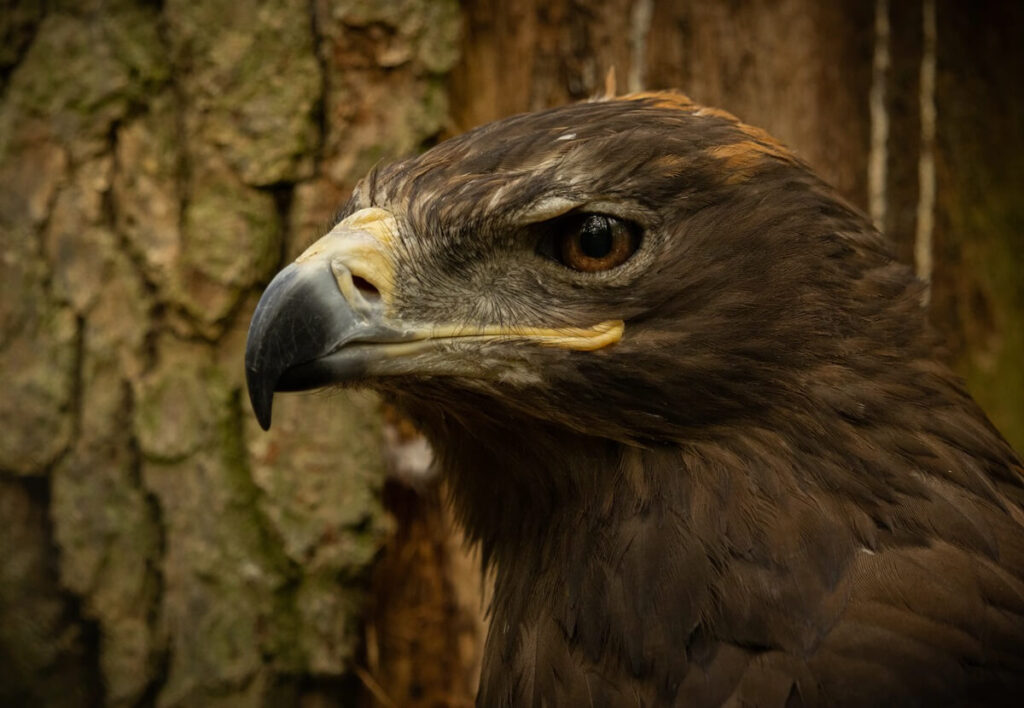


How Scientists Measure Eagle Vision
Researchers use controlled tunnel experiments where eagles are trained to identify striped patterns on screens at varying distances, receiving food rewards when they correctly identify the target screen.
Visual acuity testing for raptors involves adjusting stripe width and measuring the maximum distance at which birds reliably distinguish patterns, allowing scientists to calculate their resolving power compared to standardized human vision tests.
Golden eagles (Aquila chrysaetos), the species found in Mongolia’s Altai Mountains, have been subjects of vision studies showing they can spot rabbit-sized prey from distances exceeding 3.2 kilometers (2 miles) under optimal conditions.
Ultraviolet Vision and Hunting Advantages
Eagles possess four types of color receptors (tetrachromatic vision) compared to humans’ three (trichromatic), with the fourth receptor sensitive to ultraviolet wavelengths between 300-400 nanometers.
Rodent urine reflects UV light, creating visible trails to eagles that remain invisible to humans and the rodents themselves, allowing raptors to track prey movement patterns across open terrain even when the animals are hidden.
UV-reflective feather patterns in some bird species are visible to eagles during courtship or territorial displays, serving communication functions entirely outside human perception.
In Mongolia’s Altai region, where golden eagles are used in traditional falconry, this UV vision helps trained eagles detect vole and pika trails in snow-covered terrain during winter hunts.
Accommodation: Switching Focus Between Near and Far
Accommodation refers to the eye’s ability to change focus rapidly between near and distant objects by altering lens shape; eagles possess dual accommodation systems using both lens deformation and corneal shape changes.
A hunting eagle can shift focus from a distant scanning mode to close-up targeting during a dive reaching speeds of 240 km/h (150 mph), maintaining visual clarity throughout the rapid descent.
Human accommodation relies solely on ciliary muscles changing lens curvature, and this ability declines with age (presbyopia), typically requiring reading glasses after age 40-45; eagles maintain accommodation capability throughout their 20-30 year lifespan.
Can Humans Achieve Eagle-Like Vision?
The theoretical maximum human visual acuity is approximately 20/8 to 20/10 due to physical limitations of retinal photoreceptor density and eye dimensions; eagle vision of 20/4 to 20/5 is anatomically impossible for human eyes to replicate.
LASIK and other refractive surgeries can correct common vision problems (myopia, hyperopia, astigmatism) to achieve 20/20 or occasionally 20/15 vision, but cannot increase photoreceptor count or enlarge the foveal region to eagle standards.
Contact lenses marketed as “eagle eye” or “HD vision” improve clarity by correcting higher-order aberrations but provide no magnification or actual acuity enhancement beyond normal human limits.
Eagle Vision vs. Human Vision: Side-by-Side Comparison
Visual acuity: Eagles achieve 20/4 to 20/5 compared to the human standard of 20/20, meaning eagles can see at 20 feet what humans need to approach within 4-5 feet to discern.
Field of view: Eagles have approximately 340 degrees of visual field due to lateral eye positioning angled 30 degrees from midline, while humans have roughly 180 degrees with eyes facing directly forward.
Color receptors: Eagles possess tetrachromatic vision (4 cone types including UV) versus human trichromatic vision (3 cone types in red, green, blue spectrum).
Fovea structure: Eagles have two foveas per eye (deep and shallow) providing both forward binocular vision and lateral monocular scanning, while humans have one fovea per eye optimized for forward focus.
How many times better is eagle vision than human vision?
Eagles have visual acuity approximately 4-5 times sharper than humans, with measurements of 20/4 to 20/5 compared to the human standard of 20/20 vision. This means an eagle can distinguish details at 20 feet that a human would need to be 4-5 feet away to see clearly. However, this doesn’t mean eagles see “better” in all respects—humans have advantages in close-range color discrimination and detail work at arm’s length distances. The golden eagles used in traditional Kazakh eagle hunting in Mongolia’s Altai Mountains leverage this superior distance acuity to spot prey like foxes and hares from heights exceeding 1.6 kilometers (1 mile).
Can eagles see at night like owls?
No, eagles do not have specialized night vision and are primarily diurnal (daytime) hunters, unlike owls which are adapted for nocturnal hunting. Eagles have a higher ratio of cone photoreceptors (for color and detail in bright light) to rod photoreceptors (for dim light vision), the opposite of owls. Golden eagles typically hunt from dawn through late afternoon and roost at night. However, eagles do have superior low-light vision compared to humans due to larger pupil diameter and more efficient light-gathering capability. In Mongolia’s Altai region, eagle hunters begin their hunting expeditions at first light to take advantage of the eagles’ peak visual performance.
Do eagles have better peripheral vision than humans?
Yes, eagles have significantly superior peripheral vision with approximately 340 degrees of visual field compared to humans’ 180 degrees. This near-complete visual coverage results from eye positioning that angles 30 degrees from the head’s midline rather than facing directly forward like human eyes. Eagles sacrifice some binocular overlap (the zone where both eyes’ fields overlap for depth perception) in exchange for this expanded peripheral awareness, crucial for detecting threats and prey while soaring. However, eagles still maintain sufficient binocular vision—approximately 50 degrees of overlap—for accurate depth perception during hunting dives. This makes their vision system optimally designed for both scanning vast territories from altitude and executing precision strikes.
What animals have better vision than eagles?
Very few animals match or exceed eagle vision in overall capability. Certain falcon species, particularly the peregrine falcon, may have comparable or slightly superior acuity during high-speed hunting dives. Among mammals, no species approaches raptor visual acuity; the sharpest-eyed mammals (certain cats and primates) achieve approximately 20/20 to 20/15 vision at best. In the Mongolian Altai ecosystem, golden eagles reign as the apex visual predators with no native competitors matching their long-distance prey detection capabilities.
How far away can an eagle see a mouse?
A golden eagle can detect a rabbit-sized animal from distances exceeding 3.2 kilometers (2 miles) under optimal viewing conditions, and smaller prey like mice or voles from approximately 1-1.6 kilometers (0.6-1 mile). The actual detection distance varies based on prey contrast against the background, lighting conditions, atmospheric clarity, and the eagle’s altitude. Eagles don’t just rely on visible light detection—their ability to see ultraviolet-reflective rodent urine trails extends their effective detection range in terrain where the animals themselves might be camouflaged. Kazakh eagle hunters in Mongolia report their trained golden eagles spotting and pursuing foxes from heights of 1,000+ meters when the hunters themselves cannot yet see the prey, demonstrating this remarkable long-distance visual capability in real-world hunting scenarios.