
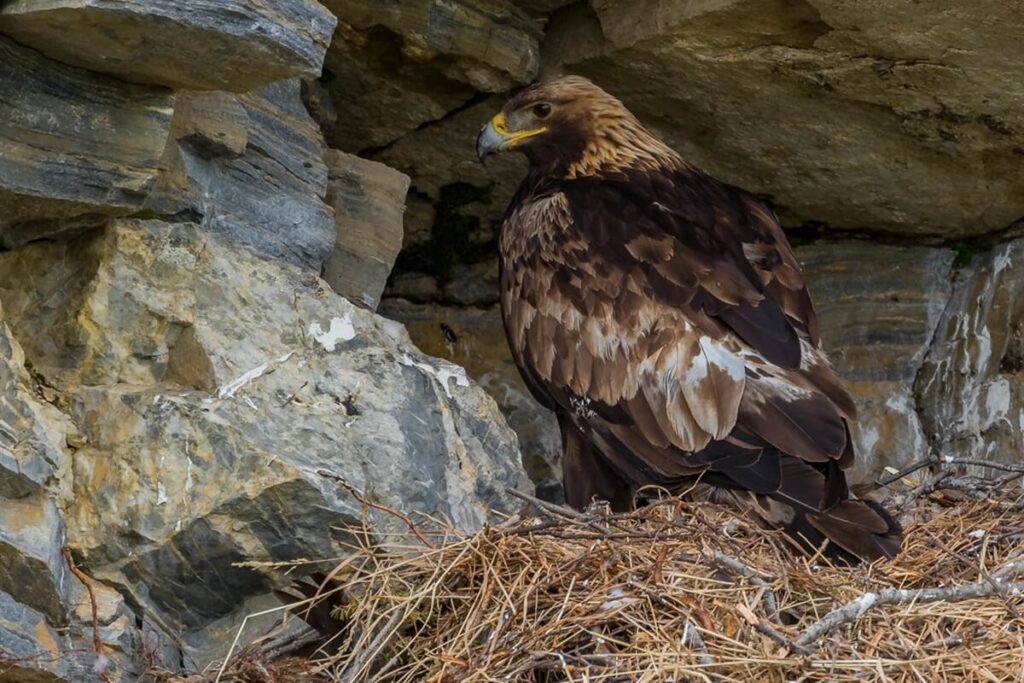
A golden eagle nest — properly called an eyrie — is a large platform of sticks and softer lining material built almost exclusively on cliff faces or tall trees. A first-year eyrie measures roughly 5–6 feet (1.5–1.8 m) wide and 2 feet (60 cm) deep, but because the resident pair adds fresh material every breeding season, the largest documented golden eagle eyrie reached 20 feet tall and 8.5 feet wide (6.1 m × 2.6 m). Eyries hold 1–3 eggs per breeding season, with chicks fledging 45–81 days after hatching.
Key Takeaways
- A golden eagle’s nest is called an eyrie (sometimes spelled aerie or aery)
- They prefer cliff ledges; tall trees are a secondary choice
- Standard first-year eyrie: ~1.5–1.8 m wide, ~60 cm deep
- Largest recorded eyrie: 6.1 m (20 ft) tall × 2.6 m (8.5 ft) wide — Cornell Lab
- Clutch size: 1–3 eggs, incubation 41–45 days, chicks fledge in 45–81 days
- Mongolian Altai eyries supply juveniles for the UNESCO-listed Kazakh eagle-hunting tradition
What is a Golden Eagle Nest Called?
A golden eagle’s nest is called an eyrie (also spelled aerie or aery, all pronounced AIR-ee or EYE-ree). The term applies specifically to the nests of large birds of prey — eagles, hawks, falcons, ospreys — built on high, inaccessible places. The word entered English in the 16th century from the Old French aire, meaning “lair” or “nest of a bird of prey.”
What makes the term useful is what it implies about the structure: height, exposure, and permanence. A robin builds and abandons a small woven cup each year. A golden eagle, by contrast, builds a stick platform large enough for two birds to stand inside, and that single nest may be reused for decades by successive generations of eagles.
Where Do Golden Eagles Build Their Nests?
Golden eagles (Aquila chrysaetos) are open-country birds. They nest in wide, treeless or lightly-treed landscapes that give them airspace to soar and hunt. Globally, the species occupies a Holarctic distribution across North America, Europe, North Africa, and Asia — including all of Mongolia.
Nest site preferences
| Substrate | Frequency | Why preferred |
|---|---|---|
| Cliff ledges | Most common | Inaccessible to ground predators, thermals for take-off, expansive view |
| Tall trees (pine, fir, cottonwood) | Secondary | Used where cliffs are absent (boreal forest, North American Great Plains) |
| Electrical pylons / artificial structures | Minor | Adopted in agricultural landscapes; rising in some regions |
| Ground (extreme cases) | Rare | Documented in the Aleutian Islands and a few treeless tundra regions |
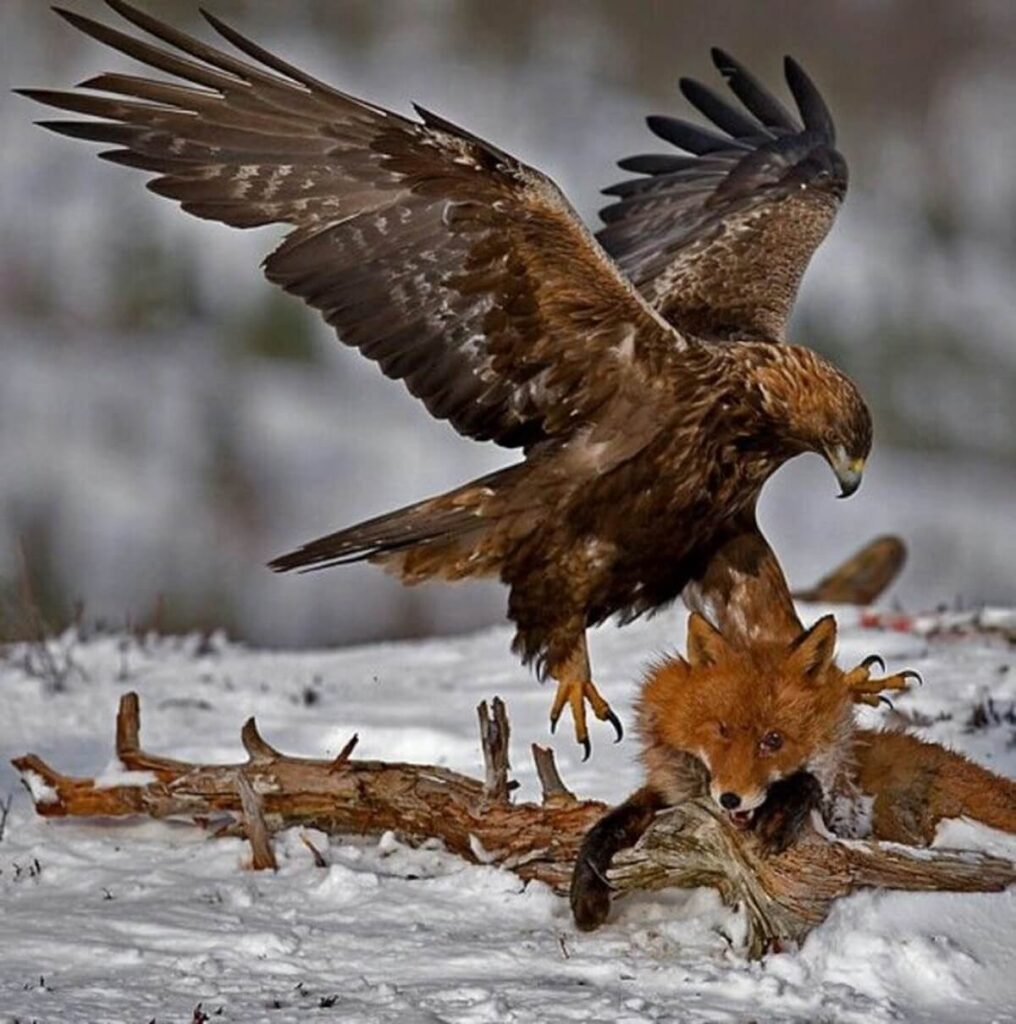
In the Mongolian Altai, where the Aquila chrysaetos daphanea subspecies (the Asian or Berkut Golden Eagle) lives, almost all eyries sit on cliff faces between roughly 2,000 and 3,500 metres elevation — the band where prey density (marmots, hares, ground squirrels) overlaps with cliff terrain.
How Big is a Golden Eagle Eyrie?
A first-year eyrie is modest: about 5–6 feet (1.5–1.8 m) wide and 2 feet (60 cm) tall, with the egg bowl itself measuring roughly 3 feet by 2 feet deep. Golden eagles are stick-adders — every breeding season the resident pair brings fresh sticks, branches, and lining material to the nest, even when they are using an alternate site that year.
Over decades, the nest grows. The largest documented golden eagle eyrie on record measured:
- Height: approximately 20 feet (6.1 metres)
- Width: approximately 8.5 feet (2.6 metres)
Such a structure has been built on, repaired, and re-lined by multiple generations of golden eagles across more than 50 years, according to long-term ornithology research.
What is a Golden Eagle Nest Made Of?
Golden eagle eyries have a consistent two-layer construction:
Layer 1 — Structural sticks The bulk of the nest is dead branches and sticks, typically a few centimetres thick and up to 1.5 metres long. Both the male and female collect them — often breaking them off live trees rather than picking them off the ground.
Layer 2 — Fresh greenery lining On top of the stick platform, golden eagles add a soft inner cup of fresh greenery — pine needles, juniper, sage, grass — replenished throughout the breeding season. The greenery is hypothesised to serve as both insulation and fumigation against parasites, since some plants the eagles select have known anti-parasitic properties.
Eyries also commonly contain bones, fur, and feathers from prey (often visible on the rim), occasional human debris (wire, plastic, fabric), and pellet remains — the regurgitated indigestible material from prey.
Eggs, Incubation, and Chick Development
A golden eagle pair typically produces one clutch per year in late winter or early spring, depending on latitude.
| Stage | Duration | Notes |
|---|---|---|
| Clutch size | 1–3 eggs (typically 2) | Eggs laid 3–4 days apart |
| Egg colour | White with brown speckling | About the size of a goose egg |
| Incubation | 41–45 days | Female does most; male brings food |
| Hatching | 1–2 days apart | Older chick gets a head start |
| Brooding | First ~4 weeks | Mother stays at nest constantly |
| Fledging | 45–81 days after hatch | First flight from eyrie |
| Independence | 32–80 more days | Parents continue feeding |
Sibling aggression (Cainism)
In nests with two chicks, the older sibling sometimes kills the younger — a phenomenon ornithologists call siblicide or Cainism (after Cain and Abel). The younger chick acts as an “insurance” hatchling: if the firstborn fails or food is plentiful, both survive; if food is scarce, only the strongest fledges.
Do Golden Eagles Use the Same Nest Every Year?
Golden eagles mate for life and are highly site-faithful. A breeding pair holds a territory and within that territory typically maintains a portfolio of multiple alternate nests, picking one each year as the active eyrie and refurbishing it before laying.
Reasons for choosing one alternate over another include disturbance the previous year, parasite load (an unused eyrie has fewer mites and lice), weather damage, and recent food availability nearby.
When one bird in the pair dies, the survivor will usually re-pair with a new mate — and the new pair often continues using the same eyrie portfolio. Some Scottish nest sites have been continuously occupied across dozens of bird-generations spanning more than a century.

Golden Eagle Nests in the Mongolian Altai
Mongolia’s western Altai range — particularly Bayan-Ölgii Province — holds one of the highest densities of breeding golden eagles in Asia. Eyries here belong almost exclusively to the Asian (Berkut) subspecies, Aquila chrysaetos daphanea — the largest of the six recognised golden eagle subspecies, with a wingspan that can reach 234 cm (over 7.6 feet).
The Kazakh eagle-hunting connection
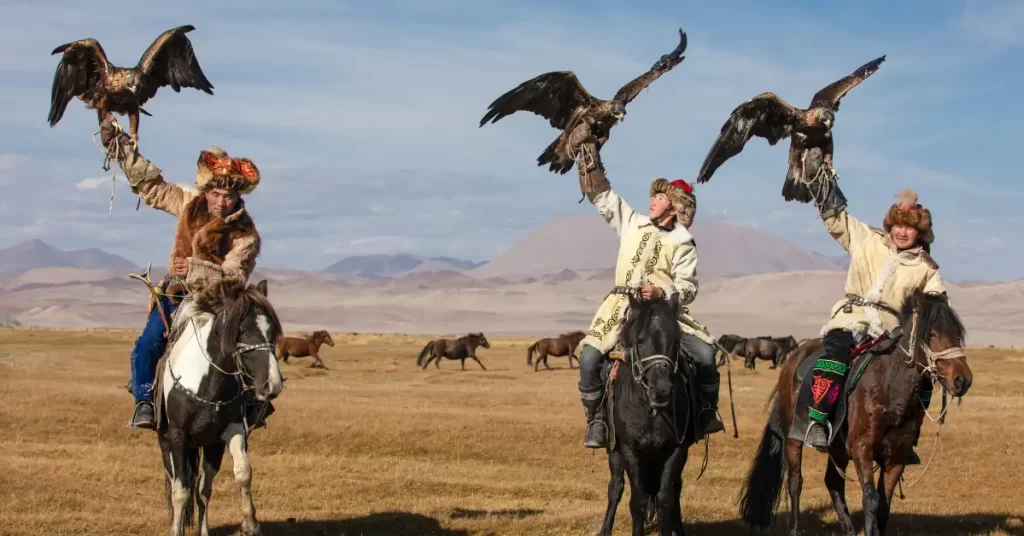
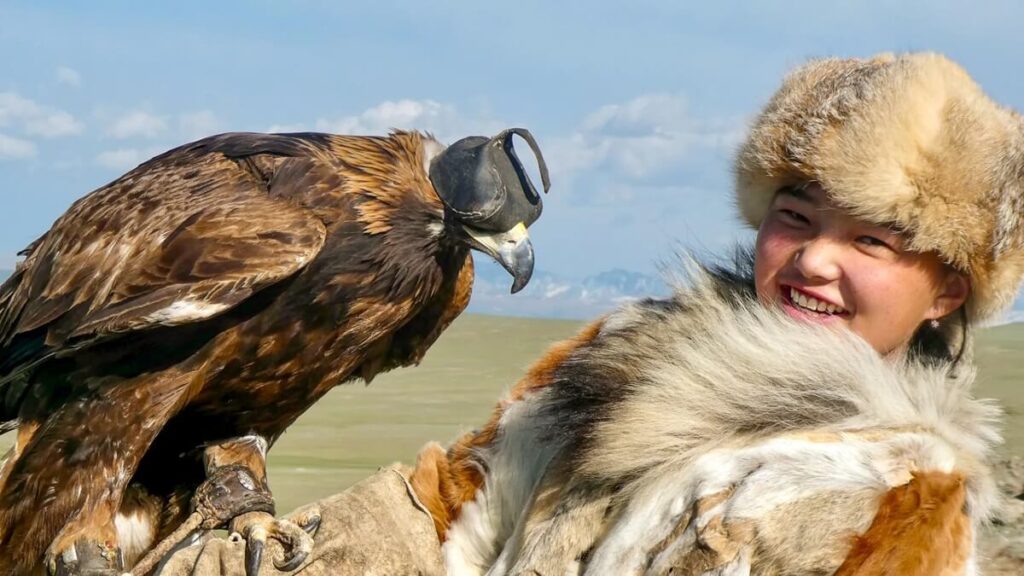
For an estimated 1,000+ years, ethnic Kazakh nomads in the Altai have practised eagle hunting (berkutchi). The tradition is internationally recognised as a living cultural heritage of humanity — falconry was inscribed in 2021 and Mongolia is among the listed practising states.

The hunters traditionally take female juvenile eagles from cliff eyries when the chicks are 3–4 months old — roughly the size at which they would naturally fledge, but before they hunt independently. The juveniles are trained for several years, then released back into the wild to breed, meaning the wild Altai population is supplemented, not depleted, by the tradition.
Visitors to Bayan-Ölgii during winter (October–March) can see trained eagles fly from the gloved fist of their hunters. The annual Sagsai Eagle Festival and the larger Golden Eagle Festival both showcase this active living heritage. To experience it firsthand, see our Mongolian Eagle Hunters tour or join a tour built around the Sagsai Eagle Festival.

Are Golden Eagle Nests Protected by Law?
The golden eagle is listed as Least Concern on the IUCN Red List, with a stable global population estimated at 170,000–250,000 mature individuals. Despite the favourable conservation status, eyries are protected almost everywhere golden eagles breed.
| Region | Law / Protection |
|---|---|
| United States | The Bald and Golden Eagle Protection Act, originally enacted in 1940 and extended to golden eagles in 1962, makes it illegal to disturb, kill, or possess any part of a nest, eggs, or feathers without permit. Maximum criminal fine for a first offence: $100,000 for individuals; civil penalties up to $5,000. |
| European Union | EU Birds Directive (2009/147/EC) — strict protection; eyries are off-limits during breeding |
| United Kingdom | Wildlife and Countryside Act 1981 — disturbing an active eyrie is a criminal offence |
| Mongolia | Law on Fauna (2000); regulated traditional take of juveniles for eagle hunting only via licensed berkutchi |
In many jurisdictions approaching a known active eyrie within 1 km is illegal during breeding season (March–July). Drone flights near eyries are universally prohibited. Wildlife photographers must hold permits.
Suggested Tours:
Suggested Blogs:
Golden Eagle Photography: How to Shoot Wild Eagles, Hunters and the Festival
Golden eagle photography rewards preparation more than luck. For birds in flight, start at 1/2500s, f/6.3, auto-ISO capped at 3200,…Eagle Festival Packing List 2026: What to Wear in Olgii’s October Cold
The Mongolia Eagle Festival in Bayan-Ölgii runs in late September and early October at elevation 1,710 metres, where October average…Sagsai vs Golden Eagle Festival 2026: Which Mongolia Eagle Festival Should You Attend?
Mongolia hosts two distinct Kazakh eagle festivals each autumn in Bayan-Ölgii Province, the country’s western Kazakh-majority region. The Sagsai Golden…













What is a golden eagle’s nest called?
A golden eagle’s nest is called an eyrie (also spelled aerie or aery). The term is used for the nests of all large birds of prey — eagles, hawks, falcons, ospreys — built on cliffs or tall trees.
Where do golden eagles nest?
Golden eagles nest primarily on cliff ledges and secondarily in tall trees where cliffs are unavailable. They prefer open habitat with thermals for soaring and abundant prey such as marmots, hares, and ground squirrels.
How big is a golden eagle nest?
A first-year eyrie is around 5–6 feet (1.5–1.8 m) wide and 2 feet (60 cm) tall. Because golden eagles add to their nests every year, eyries grow over time — the largest documented golden eagle nest measured approximately 20 feet (6.1 m) tall and 8.5 feet (2.6 m) wide.
How many eggs does a golden eagle lay?
Golden eagles typically lay 1 to 3 eggs per clutch (most often 2). Incubation lasts 41–45 days, and chicks fledge from the eyrie 45–81 days after hatching.
Do golden eagles use the same nest every year?
Not exactly — golden eagle pairs maintain multiple alternate eyries within their territory and rotate between them year to year. They are extremely site-faithful, however, and the same set of eyries can be reused by successive generations of birds for decades or even over a century.
Are golden eagle nests protected?
Yes, in nearly every country golden eagles breed in. In the United States, the Bald and Golden Eagle Protection Act (originally 1940, extended to golden eagles in 1962) makes it illegal to disturb, kill, or possess any part of an eagle, nest, eggs, or feathers without a federal permit. Mongolia regulates the traditional take of juvenile eagles by licensed Kazakh berkutchi (eagle hunters) under the 2000 Law on Fauna.