
A Kazakh wedding in Mongolia’s Altai is not a single event but a sequence of ceremonies stretching over months. It moves through matchmaking between two families, the kyz uzatu — the bride’s send-off party hosted by her own parents — and the betashar, the unveiling of the bride at the groom’s home, where a singer performs an improvised song introducing the groom’s relatives. The bride traditionally wears the saukele, a tall pointed headdress that can weigh up to seven kilograms and signals her family’s status. The celebrations centre on the toi, a large communal feast. In Bayan-Ölgii these traditions remain genuinely alive, practised by the same Kazakh families who keep the eagle-hunting heritage.
Key Takeaways
- A Kazakh wedding is a sequence of ceremonies, not a single day
- Kyz uzatu is the bride’s send-off — the first wedding party, hosted by her parents
- Betashar is the unveiling of the bride at the groom’s home, with an improvised song
- The saukele is the bride’s tall pointed headdress, weighing up to 7 kg
- The toi is the large communal wedding feast
- These traditions are living practice in Bayan-Ölgii, not staged performance
A Wedding as a Sequence, Not a Day
The Western idea of a wedding — one ceremony, one day, one venue — does not map onto Kazakh marriage tradition. A Kazakh wedding is a process: a series of distinct gatherings, hosted by different families, often spread across weeks or months.
This structure reflects something fundamental about Kazakh society. A marriage is understood as the joining of two families and two clans, not simply two individuals. Each stage of the wedding sequence formalises a different part of that joining — the agreement between families, the bride leaving her own household, her arrival into the groom’s, and finally the community celebration that confirms the new union publicly.
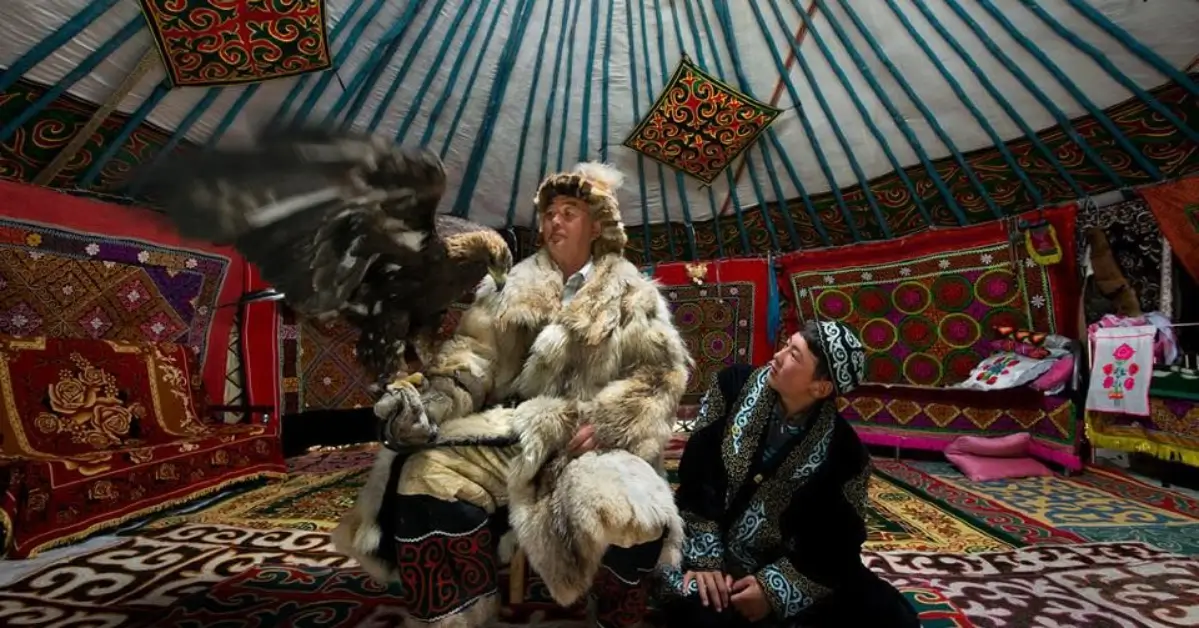
For the Kazakh community of Mongolia’s Altai, these stages have survived intact. The same families in Bayan-Ölgii who keep the berkutchi eagle-hunting tradition keep the wedding traditions, and a marriage in a Kazakh family today still moves through this recognisable sequence:
| Stage | Hosted by | What happens |
|---|---|---|
| Matchmaking | Both families | Families meet, agree the union, exchange marriage gifts |
| Kyz uzatu | Bride’s parents | The bride’s send-off party at her family home |
| Betashar | Groom’s family | Unveiling of the bride at the groom’s home, with an improvised song |
| Toi | Groom’s family / both | The large communal wedding feast that confirms the marriage publicly |
Matchmaking — Two Families, Not Two Individuals
Traditionally, a Kazakh marriage begins not with the couple but with the families. Matchmaking — the formal approach of one family to another, the negotiation, and the agreement to a union — is the opening stage.
In the most traditional form, representatives of the groom’s family visit the bride’s family to propose the match. The two families discuss the union, and the agreement is sealed with ceremony and gift-giving. This is also the stage at which marriage gifts are agreed — the exchange of goods between the families that recognises the new bond.
In modern Bayan-Ölgii, as across the Kazakh world, this has softened. Young people increasingly choose their own partners, and the “matchmaking” stage often formalises a relationship the couple has already begun rather than arranging one from scratch. But the principle endures: the families still meet, still negotiate, and still give their formal blessing. A Kazakh wedding without the two families’ involvement would not feel like a real wedding.
Kyz Uzatu — The Bride’s Send-Off
The first true wedding party is the kyz uzatu. Wikipedia’s description is precise: it is “the first wedding party organized by the parents of a bride. The literal translation is ‘to see off a daughter.'”
The kyz uzatu is hosted by the bride’s family, at the bride’s family home, and it is emotionally the most poignant ceremony of the sequence. It marks the moment the daughter formally leaves her parents’ household to join her husband’s. There is feasting, music, and celebration — but also, traditionally, sorrow. Songs of farewell are sung. The bride is, in the old nomadic understanding, leaving her family’s camp for another’s, perhaps a long ride away across the steppe.
For the bride’s parents, the kyz uzatu is their event — their last act as the hosts of their daughter. They feed the guests, they see her off, and they hand the next stage of the wedding to the groom’s family.
Betashar — The Unveiling of the Bride
When the bride arrives at the groom’s home, the central ceremony there is the betashar — the unveiling. It is “the custom (often done at the wedding) to lift a veil from the face of a bride.”
The betashar is performed with a song. Traditionally a singer — today often the mullah — “is invited to perform an improvised song, in which he mentions relatives of the groom.” The song introduces the bride, one by one, to the members of her new family: the groom’s parents, his siblings, his aunts and uncles. As each relative is named in the improvised verse, the bride bows to them, and the relative traditionally gives a gift or a blessing in return.
This is a beautiful piece of cultural engineering. The betashar does, in a single ceremony, the work of helping a young woman join an entire extended family. She learns who everyone is; they each acknowledge her; gifts and blessings flow; and only at the end is the veil lifted and her face shown. The improvised song connects directly to the wider Kazakh oral tradition — the same improvised, dombra-accompanied verse-craft seen in the aitys poetry duels.
The Saukele and the Wedding Dress
The most striking visual element of a traditional Kazakh wedding is the bride’s headdress, the saukele.
The saukele is “a traditional headpiece worn by a bride during her wedding,” with “a distinctive pointed, tall shape.” It is not a small ornament. “The weight of the saukele can sometimes reach up to seven kilograms, symbolizing the bride’s social status.”
A seven-kilogram headdress is a serious object. The saukele was historically made over a long period, decorated with silver, coral, precious stones, and fine textile work, and it represented a significant investment by the bride’s family. Its height and richness signalled the family’s standing. Wearing it through the wedding ceremonies was both an honour and a physical feat.
The saukele is the centrepiece of a fully traditional bridal outfit, worn with rich embroidered robes. In modern Bayan-Ölgii weddings, a full antique saukele may appear for the most traditional ceremonies or be replaced by a lighter modern version — but the form is instantly recognisable and remains the iconic image of a Kazakh bride.

The Toi and the Role of Community
The celebration that confirms the marriage publicly is the toi — the wedding feast. The toi is large, communal, and generous. In Kazakh culture, a family’s willingness to feed the community at a toi is bound up with honour and reputation.
A wedding toi involves: – A large gathering of relatives, neighbours, and community members – Abundant food — beshbarmak, the national dish of boiled meat and noodles, is central – Music, including the dombra, and often song and dance – Speeches, blessings, and gift-giving – Hospitality on a scale that demonstrates the families’ respect for their guests
The toi is where the private joining of two families becomes a public fact. The whole community eats together, witnesses the union, and the marriage is socially complete. In Bayan-Ölgii’s tightly-knit Kazakh communities, where families have known each other for generations, a wedding toi is a major event in the life of the whole valley, not just the couple.
Seeing These Traditions as a Traveller
Kazakh weddings are private family events, not tourist attractions — and that is exactly why witnessing one is meaningful when it happens.
What a traveller should know: – You cannot book a wedding. Weddings are not scheduled events on a tour. They happen in their own time, in their own families. – An invitation is a genuine honour. If you are staying with a Kazakh family during a homestay and a wedding falls in that window, you may be invited to attend or to part of the celebration. This is real hospitality — accept it graciously. – Bring a gift if invited. Gift-giving is woven through every stage of a Kazakh wedding. A modest, thoughtful gift is appropriate; your guide can advise. – Dress respectfully. Smart, modest clothing. This is a significant family occasion. – Follow your hosts’ lead. Watch and copy — when to sit, when to eat, when to applaud. Your guide will interpret. – Ask before photographing people, especially the bride and elders. Most families are happy to be photographed at a celebration, but courtesy comes first.
Even without attending a wedding, travellers encounter the traditions indirectly: the saukele appears in museums and cultural displays, the betashar song connects to the dombra music you may hear in a family ger, and the values behind the ceremonies — family, community, hospitality — shape every Kazakh homestay.
For travellers who want this depth of cultural contact, our Mongolian Eagle Hunter Tour and Mongolian Nomadic Life Tour place you with Kazakh families in Bayan-Ölgii. To understand the wider culture, see our guides to Kazakh dombra music, Kazakh food in Mongolia, and Kazakh clothing and heritage.
Suggested Tours:
Suggested Blogs:
Kazakh Dombra Music: The Two-String Sound of the Altai Steppe
The dombra is the central instrument of Kazakh folk music — a long-necked, two-string plucked lute that accompanies songs, carries…Naadam in Bayan-Ölgii: How Western Mongolia’s Kazakh Province Celebrates the July Festival
Naadam is Mongolia’s national festival of “the three games of men” — wrestling, horse racing, and archery — held nationally…Kazakh Food in Mongolia: A Traveller’s Guide to Altai Steppe Cuisine
Kazakh food in Mongolia’s Altai region is built on meat and dairy from four animals — horses, camels, cows, and…



What are the main ceremonies in a Kazakh wedding?
A Kazakh wedding is a sequence: matchmaking between the two families, the kyz uzatu (the bride’s send-off party hosted by her parents), the betashar (the unveiling of the bride at the groom’s home, performed with an improvised song), and the toi (the large communal wedding feast). The stages are spread over weeks or months.
What is the betashar ceremony?
The betashar is the custom of lifting the veil from the bride’s face, performed when she arrives at the groom’s home. A singer — today often the mullah — performs an improvised song that names the groom’s relatives one by one, introducing the bride to her new extended family. As each relative is named, the bride bows and they offer a gift or blessing.
What is the saukele?
The saukele is the traditional Kazakh bridal headdress — a distinctive tall, pointed headpiece that can weigh up to seven kilograms. Decorated with silver, coral, and precious stones, it symbolised the bride’s family’s social status and was a significant investment. It is the iconic image of a traditional Kazakh bride.
What is the kyz uzatu?
The kyz uzatu is the first wedding party, hosted by the bride’s parents at their home. The name literally means “to see off a daughter.” It marks the emotional moment when the bride formally leaves her own family to join her husband’s, and traditionally includes both celebration and songs of farewell.
Can travellers attend a Kazakh wedding in Mongolia?
Not as a booked activity — Kazakh weddings are private family events, not tourist attractions. However, travellers on a homestay in Bayan-Ölgii are occasionally invited to a wedding or part of the celebration if one falls during their stay. An invitation is a genuine honour; bring a modest gift, dress respectfully, and follow your hosts’ lead.
Are traditional Kazakh weddings still practised in Mongolia’s Altai?
Yes. The Kazakh community of Bayan-Ölgii Province keeps wedding traditions as living practice. While details have modernised — couples increasingly choose their own partners, and modern elements blend in — the core sequence of matchmaking, kyz uzatu, betashar, and toi remains recognisable and widely observed.