
A 10-day Mongolia motorcycle tour packing list comes down to five layers of gear: serious riding kit (full helmet, armoured adventure jacket and pants, gauntlet gloves, mid-height boots), modular clothing for 30 °C daytime to 0 °C night swings, a compact tool and spare-parts roll, a 30–50 L soft luggage system, and a lean documents-electronics-medical pouch. Everything must fit in two side bags plus a tank bag because the bike’s load limit and the unpaved sections do not forgive overpacking. The single most-forgotten item is a real waterproof base layer; the most-overpacked category is general clothing.
Key Takeaways
- Riding kit: full helmet (CE-rated), armoured jacket and pants, gauntlet gloves, mid-height boots
- Clothing strategy: layered for 30 °C → 0 °C in the same day; nothing cotton
- Bike kit: tyre repair, mini compressor, multi-tool, basic spares, chain lube
- Camp kit: light sleeping bag rated to 0 °C, headlamp, dry bag liner
- Documents: IDP, passport, insurance with motorcycle coverage in writing, credit card + cash
- Total bag count: 2 soft side bags + 1 tank bag + small daypack — never more
- Skip: jeans, cotton T-shirts, hard-shell suitcases, full mechanic toolkits, anything you’ll only “maybe” use
How Packing Actually Works on a Mongolia Motorcycle Tour
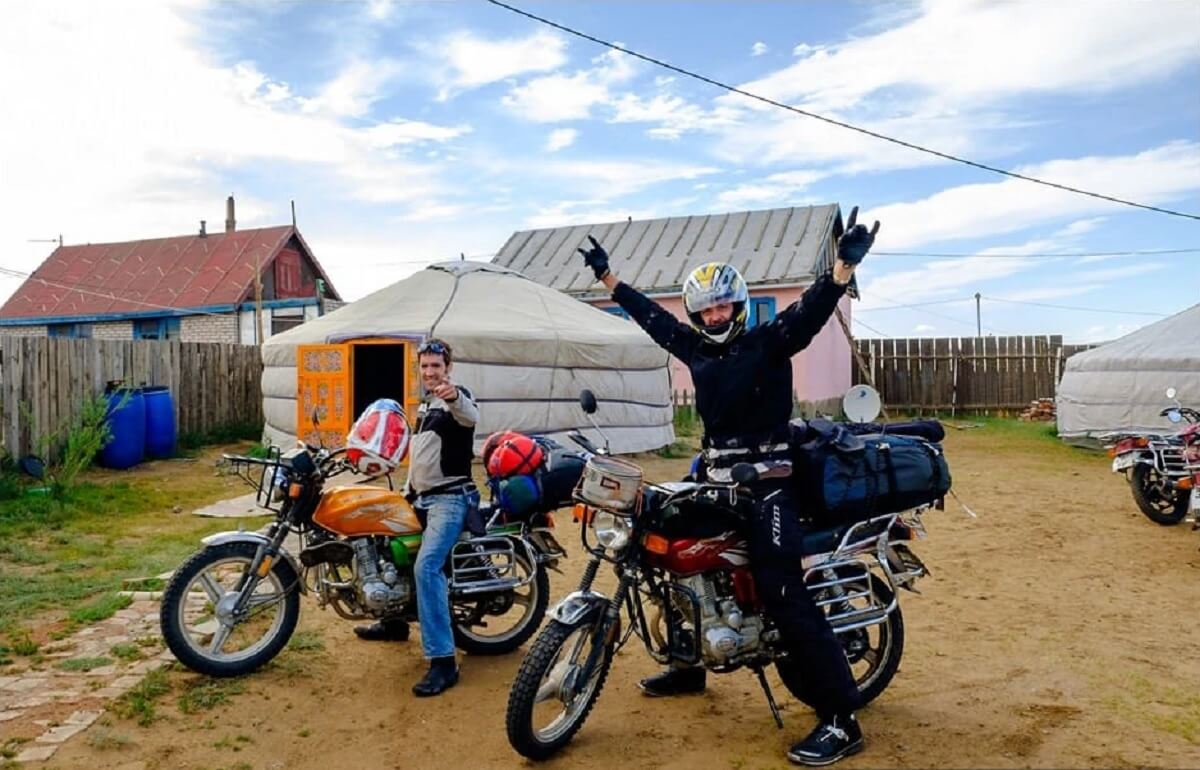
The first thing to understand is that you are not packing a suitcase. You are loading two side bags plus a tank bag plus the seat pad, and everything else either rides in the support 4×4 or stays at the hotel in Ölgii. The bike’s payload limit, the gravel sections, and the river crossings all conspire against overpacking — and the gravel section is unforgiving the moment your load shifts.
On a fully-guided Mongolia motorcycle tour with a support vehicle, your packing splits into two piles:
- On the bike — riding gear you wear, plus a tank bag for the day (rain shell, water, snacks, camera, documents, the toolkit)
- In the support 4×4 — your overnight bag with clothing, sleeping bag, camp kit, and any items you only need at the ger camp in the evening
On a self-guided rental, everything rides on the bike. The packing list shrinks brutally. Most experienced solo riders end up with one large 50 L tail bag, two small soft panniers, a 5 L tank bag, and nothing else.
Either way, the rule is the same: the heaviest items go low and forward, the lightest items go on top and rear, and nothing is loose. Mongolia’s unpaved sections will reveal every bad packing decision within the first hour.
Riding Gear: Helmet, Jacket, Pants, Gloves, Boots
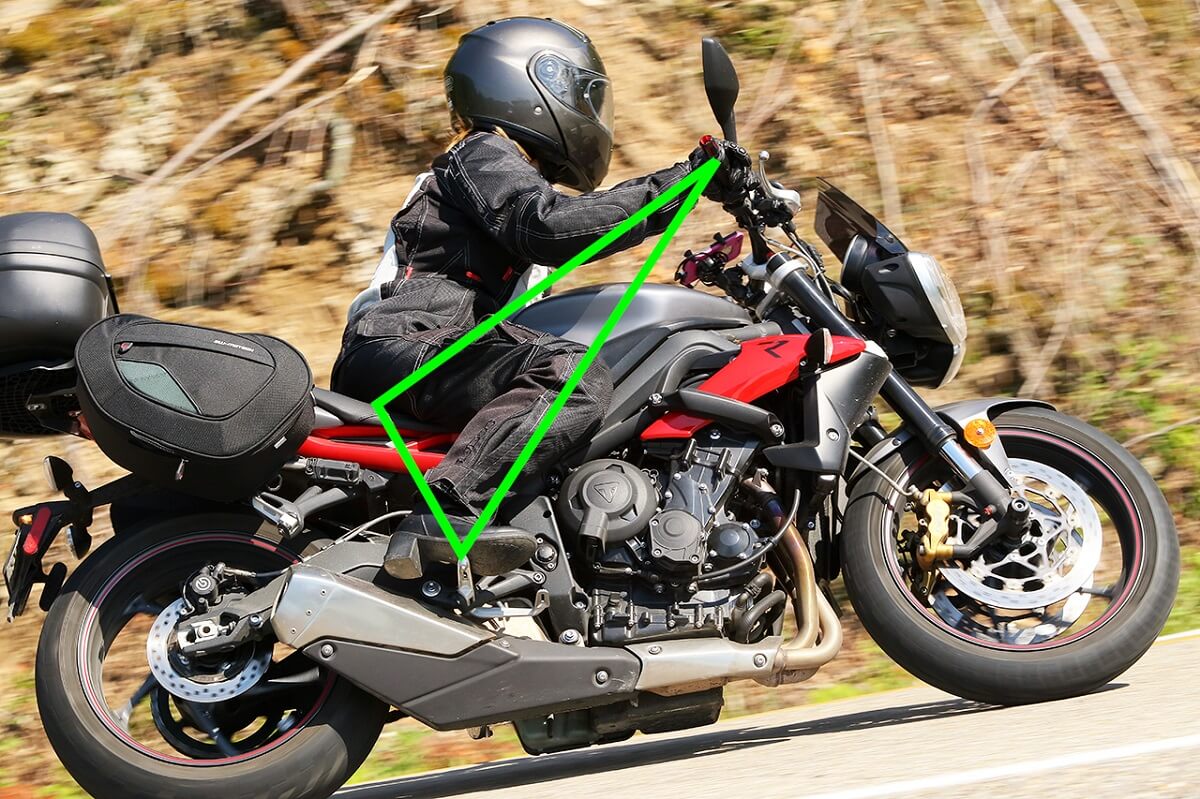
This is the category most riders try to economise on, and it is the category where economising goes badly wrong. The Altai routes mix gravel, riverbed, sand drifts and short rocky climbs — exactly the surfaces where a low-side fall happens fast and a road-only jacket offers no protection. Plan for a real fall, not a planned one.
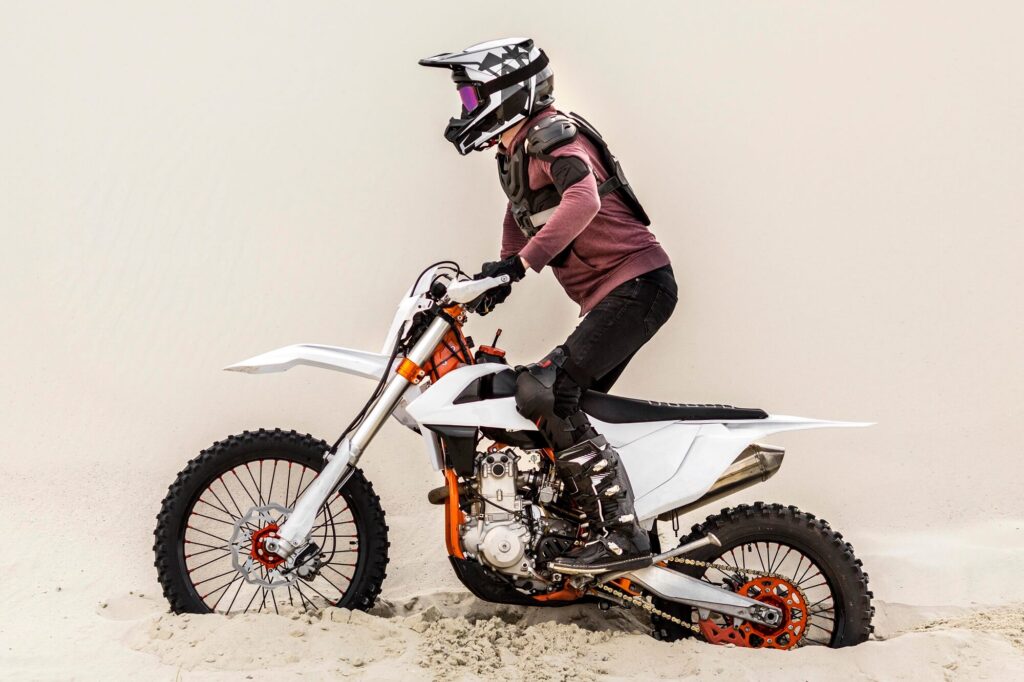
Helmet: A full-face or modular adventure helmet with a fitted visor and ventilation. Open-face is not suitable for sand and gravel kicked up by other bikes. Look for a CE 22.06 or equivalent rating, with peak/visor combo that handles low sun and dust.
Jacket: Armoured adventure jacket with CE Level 2 shoulders, elbows, and a back protector. Mongolian summer rides need a vented mesh-style jacket with a removable waterproof liner — the temperature swing across a single day can be 25–30 °C, and you want one jacket that handles all of it. Brands and price points vary widely; the floor is roughly $300 for serviceable gear.
Pants: Armoured adventure pants with knee and hip protection. Avoid jeans — they offer no abrasion protection and absorb water. Many riders pair a base layer with armoured pants and skip the heavier riding pants in favour of a textile/mesh hybrid.
Gloves: Two pairs. One short-cuff summer glove for hot riding days, one full-gauntlet adventure glove for cold mornings and river-crossing sections. Waterproof or quick-dry both.
Boots: Mid-height adventure or enduro boots with ankle protection and a stiff sole. Hiking boots do not work — you need ankle support against side impacts. Touring boots are too soft for off-road riding. The right answer is a true adventure boot in the $250–$400 range.
Layered Clothing for the Steppe Climate
Western Mongolia’s continental climate means daytime highs of 25–30 °C on the steppe in July, dropping to 0–5 °C overnight at the lake basecamps near Tavan Bogd. Wind chill while riding can push the perceived temperature 10 °C lower than the actual reading. The right approach is three thin layers, not one thick layer, with everything synthetic or merino — never cotton.
A working layered kit for a 10-day Mongolia ride:
| Layer | Item | Notes |
|---|---|---|
| Base | 2× merino long-sleeve T-shirt | One day, one for evening; merino doesn’t smell |
| Base | 2× merino boxer briefs or briefs | Quick-dry, wear under armoured pants |
| Mid | 1× thin fleece pullover | For cold mornings under the jacket |
| Mid | 1× lightweight down jacket (700+ fill) | Compresses to softball size; evening warmth |
| Shell | 1× packable waterproof shell jacket | Backup for sudden mountain rain |
| Camp | 1× warm beanie + 1× thin scarf or buff | Evenings at 4,000 m get cold fast |
| Camp | 1× pair lightweight camp pants | Synthetic, for evenings after riding |
| Camp | 2 pairs merino hiking socks | Off-bike use, wash and rotate |
| Socks | 3 pairs riding socks | Synthetic, knee-high to prevent boot rub |
The single missed item that 80% of riders regret is a proper waterproof shell. Mongolian afternoon thunderstorms drop temperatures by 10 °C in 20 minutes and you cannot ride out from under them; you want a real shell, not a “water-resistant” jacket.
Tools, Spares, and Bike-Specific Gear
On a guided tour, the support vehicle carries the major spares, the air compressor, and the mechanic. Your personal tool kit can be light. On a self-guided rental, you carry everything. Either way, the following always lives on or near the bike:
- Tyre repair kit for tubeless or tube — match your bike
- Mini compressor or 4 CO₂ cartridges to seat a tyre on the trail
- Tyre pressure gauge — small dial type
- Compact multi-tool with screwdriver bits, hex keys, plier function
- Tyre levers (2× short) — only if you have tubes
- Chain lube — small bottle; chain dries out fast in dust
- Spare clutch lever + brake lever — single biggest crash-related spare
- Spare clutch cable if your bike is cable-operated
- Zip ties (10× heavy duty), gorilla tape (1 roll), wire (2 m)
- Spare fuses + LED bulb for tail/indicator
- Headlamp with red mode for night work and tent use
- Small first aid kit with bandages, antiseptic, painkillers, ibuprofen, anti-diarrhoeal
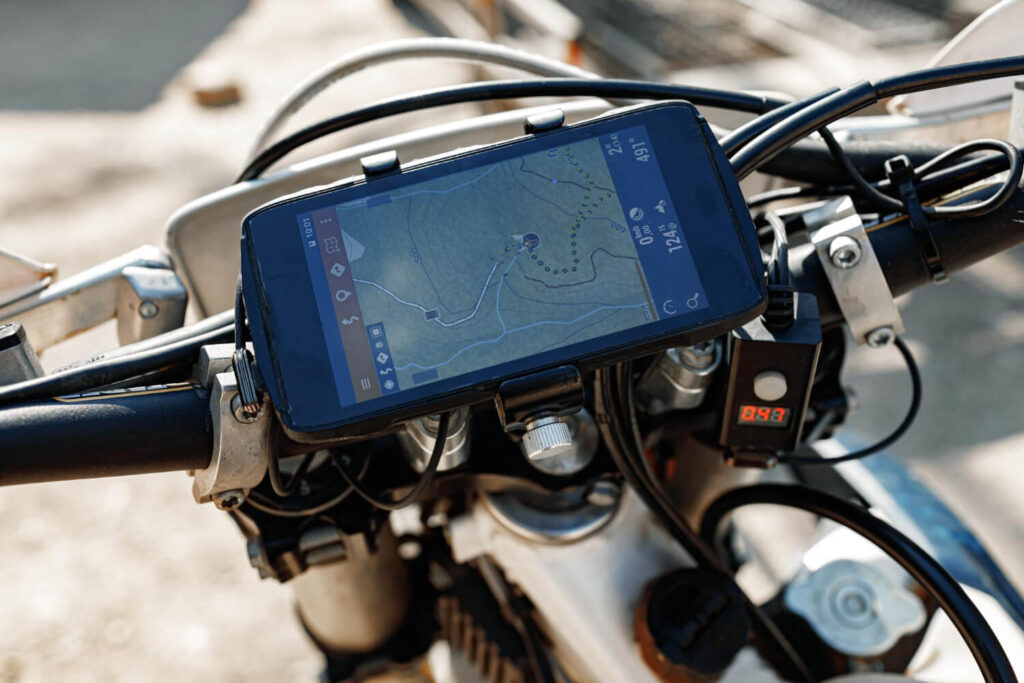
For self-guided riders only: – Spare tube (front + rear, or universal 21″ tube as bridge) – Spare spark plug – Chain master link – Small bottle of engine oil (200 ml) – GPS or downloaded offline maps — Mongolia has spotty coverage; carry redundancy
Camp Kit and Overnight Gear
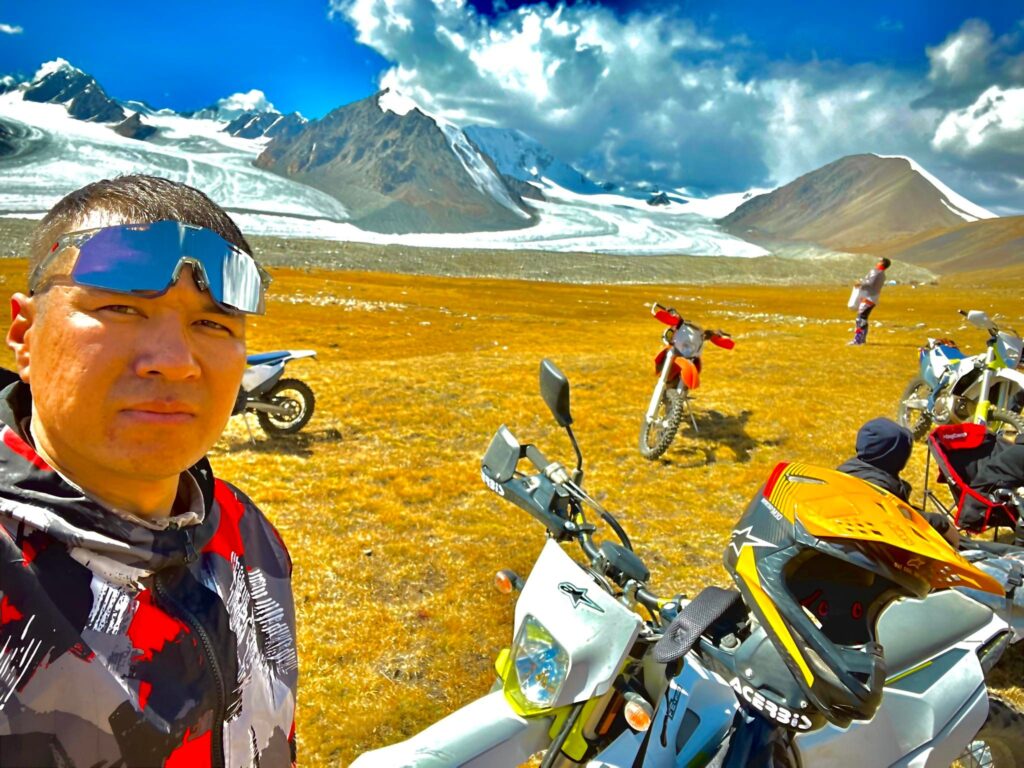
Ger camp nights are warm and dry — the gers themselves are wood-stove heated. Mountain lake basecamp nights, especially near Khoton and Khurgan, can drop to freezing even in mid-July. Pack for the colder scenario:
- Sleeping bag rated to 0 °C (synthetic preferred; quick-dry if soaked)
- Compact silk or thin sleeping bag liner — adds 5 °C warmth, doubles as ger bedding
- Compact inflatable pillow — the small ones; ger pillows are bulky
- Headlamp + spare batteries — ger camps don’t always have electricity
- Earplugs — gers can be lively, dogs bark, wind howls
- Quick-dry travel towel (small to medium)
- Soap or 2-in-1 wash — biodegradable; some camps have showers, some don’t
- Toothbrush, toothpaste, basic toiletries — small sizes; resupply impossible in the bush
- Lip balm with SPF — high altitude UV is brutal
- Sunscreen SPF 50+ — small bottle; reapply twice a day on the bike
Documents, Electronics, and Money
Keep this category tight and waterproof. It rides in your tank bag for the entire trip, never in checked luggage and never in the support vehicle:
| Item | Notes |
|---|---|
| Passport with 6+ months validity | Mandatory; photocopy in a separate bag |
| Mongolia visa (if your nationality needs one) | Print + digital copy |
| International Driving Permit | 1949 Geneva Convention type; carry the physical document |
| Home-country motorcycle licence | The IDP without the home licence is invalid |
| Travel insurance with motorcycle coverage in writing | Print confirmation; show at pre-departure briefing |
| Vaccination card | Optional but useful for ger family visits |
| 2 credit cards | Different networks; many places in Ölgii only take cash |
| $200–$400 USD cash | Small bills; for tips, ger camps, fuel emergencies |
| Mongolian SIM card + small phone | Buy at UB airport; useful in towns only |
| Power bank (10,000 mAh+) | Ger camps may not have power; charge devices at night |
| USB-C and Micro-USB cables | Carry both; humid dust kills cheap cables fast |
| GoPro or compact camera + spare battery | Phone gets dust-fouled fast on the bike |
| Headphones or earbuds | For flights and ger evenings |
What NOT to Bring (The Common Mistakes)
The list of things you should leave at home is almost as important as the list of things to bring. Repeated mistakes from international riders:
- Jeans or cotton trousers — no protection, absorbs water, takes days to dry
- Cotton T-shirts — once wet, stay wet; cold-weather hazard
- Full hard-case mechanic toolkit — the support truck carries this
- A second pair of riding boots — you’ll only wear one pair the whole trip
- Roller suitcases — useless in the support vehicle; pack soft only
- Heavy down sleeping bag rated to -20 °C — overkill for July/August; bulky and heavy
- Mosquito net — gers are sealed; mosquitos are not the issue at altitude
- Bulky camera tripod — you won’t use it; mini gorilla pod is enough
- Excess electronics — laptop, tablet, drone all add weight and risk for no on-trip use
- More than 2 changes of riding clothes — laundry happens at the Ölgii return point
- Energy bars / camping food from home — Mongolian camp cooking is excellent; bring nothing
- Hard-tail tail bag — the soft compressible bags ride better on dirt
The general principle is one of each thing, never two. A 10-day Mongolia motorcycle tour pulls roughly half the gear out of a normal motorcycle traveller’s instinct.
Suggested Tours:
Suggested Blogs:
Self-Guided vs Guided Motorcycle Tour in Mongolia: Which One Actually Fits Your Ride?
For roughly 85% of international riders, a fully-guided Mongolia motorcycle tour is the right format — the supported package costs…Mongolia Motorcycle Tour Cost in 2026: What You’ll Actually Pay (and What’s Included)
A guided 10-day Mongolia motorcycle tour costs around $3,600 per person in 2026 when booked through a licensed local operator…Ulgii to Altai Tavan Bogd by Motorbike: Real Road Conditions, Fuel Stops and Timing for the 2026 Season
The motorbike route from Ölgii to Altai Tavan Bogd National Park runs roughly 180 km one-way along the southern corridor…

How heavy can my packed gear be?
Most guided tours allow up to 15 kg per rider in the support 4×4 (one duffel) plus whatever fits on the bike — typically another 8–12 kg in soft luggage. The total practical limit is around 25 kg of personal gear. Self-guided rentals usually cap the rider at 20 kg total because the bike carries everything; if you have more, the operator may decline the rental or charge an excess-load surcharge.
Can you rent riding gear in Mongolia or do you have to bring your own?
Helmets and basic gear can be rented from some operators for $100–$200 for the full trip, but availability and sizing are unpredictable. Bring your own gear if you have any at all. Custom fit and known-good safety rating matter more on the Altai than on any road ride at home, and renting in Ölgii is a fallback option, not a primary plan.
What about laundry on a 10-day Mongolia motorcycle tour?
There is no real laundry between Ölgii and the lake basecamps — you arrive, you ride, you sleep in a ger, you ride again. Most riders wash one set of socks and underwear by hand each evening using camp soap, hang it overnight in the ger, and rotate. A single load of proper laundry typically happens at the hotel night when the tour returns to Ölgii on day 5 or 6 of a 10-day loop.
Do you need a sleeping bag if you’re staying in gers?
Yes — ger camps provide blankets but most riders find them insufficient for the colder nights at the lake basecamps near Tavan Bogd. A 0 °C synthetic sleeping bag inside a silk liner is the right answer; the combo packs down small and handles the worst-case night at 4,000 m. On hotel nights in Ölgii at the start and end, the bag stays in the support vehicle.
What’s the one item experienced riders always bring that beginners forget?
A second helmet visor — clear and tinted, swapped out depending on conditions. Mongolian roads run east-west across open steppe, and low sun in the morning or evening can blind you for 30–60 minutes at a time. The fix is a tinted visor in a soft pouch in the tank bag, swapped in 30 seconds at a rest stop. Other commonly-forgotten items: a second pair of riding gloves, a real headlamp, and a tube of electrolyte tablets.