
Mountain rescue in Mongolia is limited and self-organised. There is no national equivalent of the Swiss Air-Glaciers, French PGHM, or US National Park Service search-and-rescue service — instead, response is coordinated through the Mongolian Border Service, local provincial emergency teams (NEMA), and the climber’s own licensed tour operator. Helicopter evacuation from the Altai is rare and weather-dependent; ground evacuation by horse and 4×4 from a high-mountain incident typically takes 24–72 hours. This is why comprehensive travel insurance with high-altitude rescue coverage is not optional for climbers attempting Mount Khüiten or any peak above 3,500 m, and why every expedition must travel with a licensed Mongolian operator.
Key Takeaways
- No national mountain-rescue service — response is operator-coordinated
- NEMA (National Emergency Management Agency) handles regional emergencies
- Helicopter evacuation: rare, weather-dependent, expensive (USD 5,000–15,000 self-paid)
- Ground evacuation: 24–72 hours typical from a Tavan Bogd incident
- Travel insurance with high-altitude coverage to 5,000 m is mandatory
- The licensed tour operator is your first emergency contact — not 105/103/102
Who Actually Responds to a Mountain Emergency in Mongolia?
Unlike alpine countries with dedicated mountain rescue services, Mongolia coordinates emergency response through three overlapping organisations:
1. The licensed Mongolian tour operator (your first call). Every climber on Mount Khüiten or in the Tavan Bogd massif must be with an accredited operator. The operator is your first contact point because they have the satellite phone, the local logistics network, and the authority to coordinate with government bodies. Their guide stays with you and your team until evacuation completes.
2. The Mongolian Border Service. Because the entire Tavan Bogd region sits within Mongolia’s strict frontier zone, the Border Service is the on-ground authority. They have outposts at Ölgii and at high-mountain checkpoints, and they coordinate any movement of personnel into rescue zones.
3. NEMA — National Emergency Management Agency. Mongolia’s national emergency body. NEMA controls the small number of helicopters available for emergency use, but their operational area covers the entire country. Helicopter availability depends on weather, fuel, crew scheduling, and competing priorities — none of these favour a remote alpine evacuation.
Mongolia does NOT have: – A dedicated mountain rescue squad like the French PGHM or Swiss Air-Glaciers – 24/7 helicopter rescue on-call from the Altai – Mountain medics positioned at base camps – Rapid-response avalanche dogs
This is the reality, not a complaint — it’s why climbers must plan around the gap.
Helicopter Evacuation Reality
A helicopter from Ölgii or Ulaanbaatar to a high-mountain incident in Tavan Bogd is rare, weather-dependent, and expensive.
| Factor | Reality |
|---|---|
| Availability | NEMA helicopters serve all of Mongolia; alpine evacuations compete with floods, fires, and medical priorities elsewhere |
| Weather window | Mountain ceiling, visibility, and wind must all be inside operational limits — not always the case at altitude |
| Distance | Ölgii to Tavan Bogd base camp is ~150 km; Ulaanbaatar is ~1,600 km |
| Cost (self-paid) | USD 5,000–15,000 typical, settled before or immediately after evacuation |
| Time to dispatch | Best case: 4–8 hours from request. Realistic case: 12–48 hours |
| Landing zones | The Potanin Glacier base camp area allows landing in summer; higher altitudes do not |
For a serious medical emergency at 4,000 m, the operator typically initiates ground evacuation first while requesting helicopter support in parallel — because the helicopter may or may not arrive in time.
Ground Evacuation Timeline
The realistic ground evacuation from a Mt Khüiten high-camp incident:
| Stage | Time | Who/how |
|---|---|---|
| Incident at high camp (4,000 m) | T+0 | Guide stabilises patient, calls operator via satellite phone |
| Stretcher descent to base camp (3,400 m) | T+6 to T+12 hrs | Guide team + remaining climbers in the group |
| Horse transport from base camp to vehicle road | T+12 to T+24 hrs | Pre-positioned Kazakh herder horses + guide |
| 4×4 transport to Ölgii city | T+24 to T+30 hrs | Operator vehicle (6–8 hours of rough road) |
| Stabilisation at Ölgii hospital | T+30 to T+36 hrs | Provincial hospital, basic capabilities |
| Onward evacuation to Ulaanbaatar | T+36 to T+72 hrs | Domestic flight (3 hours) — only after stabilisation |
The total ground-only evacuation is 30–72 hours depending on weather, season, and the patient’s condition. For severe trauma or HACE/HAPE this is a long time.
Critical Insurance Coverage Requirements
Travel insurance is non-negotiable for any climbing trip in Mongolia. The required coverage:
Mandatory coverage: – High-altitude trekking up to 5,000 m (specifically named in the policy — Mount Khüiten is 4,374 m so 4,500 m minimum, 5,000 m to be safe) – Helicopter evacuation (not just “emergency evacuation” — must specifically include helicopter) – Repatriation to home country on medical grounds – Trip interruption for serious illness or injury – Coverage limit of at least USD 100,000 medical + USD 50,000 evacuation
Insurers commonly used by Khüiten climbers: – Global Rescue — specialises in alpine evacuation – World Nomads — accepts mountaineering up to 5,000 m on the Explorer plan – IMG Global — high coverage limits, mountaineering rider – Travelex — Premier plan with adventure sports rider
What invalidates your insurance: – Climbing without a licensed Mongolian operator – Trekking without the required border-zone permit – Climbing outside the operator’s stated route or schedule – Failing to declare the activity at policy purchase
Checking your coverage: call your insurer before departure and have them confirm in writing that “mountaineering up to 5,000 m in Mongolia, including helicopter evacuation” is covered. Without this written confirmation, assume you are not covered.
Emergency Contacts Before You Go
Save these to your phone and write them on a laminated card you carry in your pack:
| Service | Number / Contact |
|---|---|
| Your licensed tour operator | (provided at booking — first call always) |
| Mongolia general emergency | 105 |
| Police | 102 |
| Ambulance | 103 |
| Fire | 101 |
| NEMA national hotline | 108 |
| Ölgii regional hospital | (provided by operator — varies by season) |
| Your country’s embassy in Ulaanbaatar | (look up before departure) |
For climbers from countries with weak embassy presence in Mongolia, the US Embassy in Ulaanbaatar maintains a citizen-services list that can be a useful fallback. The UK FCDO and Australian DFAT also publish travel advisories with current emergency information.
A satellite communicator — Garmin inReach or SPOT X — is strongly recommended for any climb above 3,500 m. Mobile coverage in the Altai is essentially zero outside Ölgii city.
Self-Rescue Gear and Skills You Must Bring
Because rescue is slow, you must be able to handle the first 24–72 hours yourself. The mandatory gear list for any Khüiten climber:
Personal first-aid kit: – Bandages, gauze, tape, scissors – Painkillers: ibuprofen + paracetamol – Anti-altitude sickness: acetazolamide (Diamox) — pre-prescribed – For severe AMS: dexamethasone (prescription, used only on guide instruction) – Antihistamines for unexpected allergic reactions – Personal prescription medications + 5-day buffer supply – Blister care kit (Compeed or moleskin)
Communication: – Satellite communicator with active subscription – Spare batteries for headlamp + GPS – Whistle attached to your jacket
Self-rescue: – Crevasse-rescue cord and pulley (for glacier travel teams) – Emergency blanket (silver foil) – Spare insulated jacket beyond what you wear daily
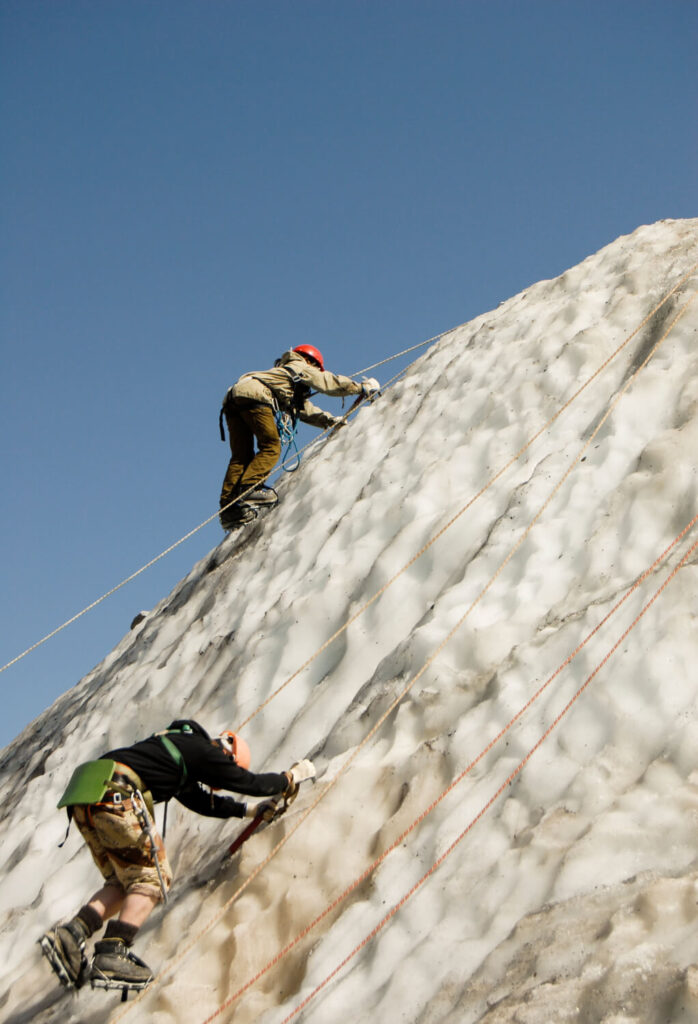
Skills you must have practised (not just read about): – Self-arrest with ice axe on a snow slope – Crampon technique on 30°+ ice – Tying a bowline and prusik knot – CPR – Recognising AMS, HACE, and HAPE symptoms
Most operators provide a half-day skills refresher at base camp covering self-arrest and crevasse rescue, but the basics must already be in your hands before arrival.
What to Do if Something Goes Wrong
The protocol every climber on a Mongolian expedition should know:
1. Stop and assess. Don’t move an injured climber until you’ve checked for spinal injury or other complications. 2. Tell the guide immediately. They have the satellite phone and the chain of command. 3. Stabilise the patient. Get them out of the wind, into shelter, hydrated, and warm. 4. Document. Note the time, what happened, what symptoms, what you’ve given them. The receiving hospital will need this. 5. Help with evacuation. Stretcher descent requires 4–6 people; everyone on the team helps. 6. Notify family at the right moment — through the operator’s office, not directly. The operator will reach the listed emergency contact on your booking form.

For climbers booking through us, see our Mt Khüiten Climb tour — every booking includes the satellite phone, emergency protocols, and a pre-departure briefing on rescue logistics. For broader expedition planning, see our Khüiten climbing season guide and Altai Tavan Bogd trekking routes.
Suggested Tours:
Suggested Blogs:
Khüiten Peak Climbing Season: Best Months, Weather Windows, and Why Most Climbs Happen in July–August
The Khüiten Peak climbing season runs from late June to mid-September, with July and August as the prime climbing months…Mountain Climbing Risks: Exploring the Challenges and Safety Measures
Mountain Climbing Risks: Exploring the Challenges and Safety Measures – Mountain climbing is an exhilarating and adventurous activity that has…9 tips about rock climbing basics for mountaineers
Rock climbing basics are an essential skill for mountaineers, providing the techniques and confidence needed to tackle challenging terrain safely…


Is there a mountain rescue service in Mongolia?
There is no dedicated mountain rescue service like the Swiss Air-Glaciers or French PGHM. Emergency response in the Altai is coordinated through your licensed tour operator, the Mongolian Border Service, and NEMA (National Emergency Management Agency). Helicopter evacuation is rare and weather-dependent.
How long does mountain evacuation take in the Mongolian Altai?
Realistic ground evacuation from a Mt Khüiten high-camp incident takes 30–72 hours to reach Ölgii hospital, plus another 3 hours for the domestic flight to Ulaanbaatar. Helicopter evacuation can shorten this dramatically when available, but availability depends on weather, fuel, and competing priorities.
How much does helicopter rescue cost in Mongolia?
Helicopter evacuation from the Altai typically costs USD 5,000–15,000 and is settled either before dispatch or immediately on arrival. Without travel insurance specifically covering helicopter evacuation, you pay this from your own funds.
What insurance coverage do I need for climbing in Mongolia?
At minimum: mountaineering coverage to 5,000 m altitude, helicopter evacuation, repatriation to home country, and USD 100,000 medical / USD 50,000 evacuation limits. Specialist providers include Global Rescue, World Nomads (Explorer plan), IMG Global, and Travelex Premier. Get the coverage confirmation in writing before departure.
What emergency number do I call in Mongolia?
For mountain emergencies, call your licensed tour operator first — they have the satellite phone and direct line to the Border Service and NEMA. The general Mongolian emergency number is 105, with police 102, ambulance 103, and NEMA 108. Mobile coverage in the Altai is essentially zero outside Ölgii city, so a satellite communicator (Garmin inReach or SPOT X) is strongly recommended.
Can I climb Mount Khüiten without travel insurance?
Technically possible, but no licensed Mongolian operator should accept you on the trip without proof of high-altitude travel insurance. Climbing without coverage means you bear all rescue, hospital, and repatriation costs personally — which can run USD 50,000+ for a serious incident requiring helicopter evacuation and medical repatriation.